

India’s growing private space sector is turning its attention to a critical but often overlooked piece of infrastructure: navigation.
From smartphones and ride-hailing services to drones, aviation, maritime systems, telecommunications and defence, modern life increasingly depends on precise positioning, navigation and timing, commonly known as PNT. But heavy reliance on satellite navigation signals from high-altitude constellations also creates vulnerabilities, particularly in environments affected by jamming and spoofing.
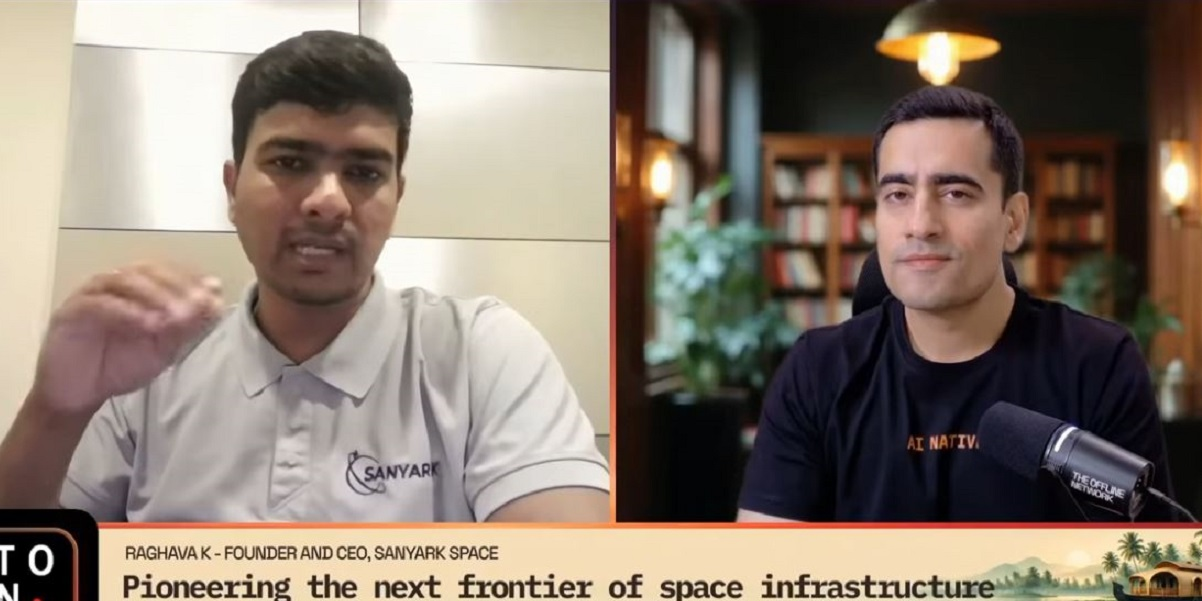
Raghav, a former ISRO engineer and now part of space startup Sanyakspace, believes low Earth orbit (LEO) satellites could play an important role in addressing these challenges and strengthening India’s navigation capabilities.
The vulnerability of conventional satellite navigation
Global navigation satellite systems such as GPS, Galileo, BeiDou and India’s NavIC operate primarily from much higher orbits than LEO. The signals travel thousands of kilometres before reaching receivers on Earth, making them relatively weak by the time they arrive.
That weakness can be exploited through jamming, which blocks navigation signals, or spoofing, in which false signals are transmitted to deceive a receiver about its location or timing.
For civilian users, such disruptions can cause inaccurate positioning. For defence, aviation and maritime operations, however, the consequences can be considerably more serious.
India has been working to strengthen its sovereign navigation capability through NavIC, but the next generation of applications is demanding greater accuracy, resilience and reliability.
Why LEO could change the equation
LEO satellites operate much closer to Earth than traditional navigation satellites. According to Raghav, this allows them to deliver significantly stronger signals and potentially improve positioning accuracy.
The approach being explored by Sanyakspace is not necessarily to immediately replace existing navigation constellations. Instead, its initial concept is to complement systems such as GPS and NavIC by transmitting corrections that can improve the accuracy of existing positioning signals.
The company sees this as a stepping stone toward a more independent navigation architecture.
A single LEO satellite cannot provide continuous positioning coverage because it moves rapidly around Earth. Persistent coverage therefore requires a constellation of satellites. Raghav estimates that a regional system would require tens of satellites, while a globally independent architecture could eventually require hundreds.
Smaller satellites, new opportunities
One of the key differences between traditional navigation satellites and the LEO approach is satellite size.
Conventional navigation satellites can weigh several tonnes, while Sanyakspace is developing satellites in the roughly 100-kilogram class.
The company is also focusing on miniaturising the technologies required for navigation. Atomic clocks are particularly important because satellite navigation depends on extremely precise timing.
Traditional navigation satellites use relatively large and sophisticated atomic-clock systems. Sanyakspace is instead using chip-scale atomic clocks, which are dramatically smaller and lighter, although they offer different performance characteristics.
The startup says its core navigation payload and antenna are being designed and developed indigenously, while it is working with existing Indian satellite-bus companies rather than rebuilding every component from scratch.
From defence to everyday applications
Resilient navigation has applications far beyond military systems.
As autonomous vehicles, advanced driver-assistance systems, precision drones and automated logistics develop, positioning errors of several metres can become increasingly problematic.
High-precision navigation could also support applications ranging from drone operations and aviation to maritime navigation and location-based services.
For defence users, resilience is particularly important. A navigation system that can operate across different signals, frequencies and architectures could provide an additional layer of protection when conventional GNSS signals are disrupted.
The broader objective is therefore not simply greater accuracy, but greater reliability under hostile or degraded conditions.
Building an Indian space ecosystem
The challenge extends beyond satellites themselves. Navigation requires ground infrastructure, receivers, precise timing systems and a broader ecosystem capable of integrating new signals.
Sanyakspace says it plans to work with existing receiver manufacturers rather than compete directly with companies already supplying navigation hardware.
The strategy reflects a broader trend in India’s private space sector: startups are increasingly building specialised technologies while collaborating with established companies for components, satellite buses, ground infrastructure and downstream applications.
The company is also pursuing greater domestic manufacturing over time. Some specialised components, including chip-scale atomic clocks, are currently imported, but the long-term objective is to indigenise more of the technology as India’s semiconductor and deep-tech ecosystem develops.
Talent becomes a strategic advantage
India’s private space industry is also benefiting from a growing pool of specialised engineering talent.
Sanyakspace says its team currently includes around 35 people, including PhDs and engineers with advanced degrees. Some members have previously worked or studied overseas before returning to India.
This reverse flow of specialised talent could become increasingly important as Indian startups move into areas such as satellite communications, navigation, avionics, RF systems and semiconductor technologies.
For companies operating in highly specialised fields, attracting engineers and researchers with experience in these areas remains one of the biggest challenges.
A more sustainable space economy
The expansion of satellite constellations also raises another concern: space sustainability.
As thousands of satellites enter orbit for communications, navigation, Earth observation and other applications, operators will increasingly need to plan for the full lifecycle of spacecraft from launch and operation to servicing and eventual deorbiting.
Raghav argues that responsible satellite disposal will become an integral part of the emerging space economy. Companies are also exploring technologies that can extend the operational life of satellites, potentially reducing both costs and orbital congestion.
India’s space ecosystem is consequently moving beyond the traditional launch-focused model toward a broader value chain that includes spacecraft manufacturing, satellite services, navigation, data and downstream applications.
The road ahead
India’s navigation future is unlikely to be defined by a single satellite system. Instead, it could involve multiple layers of infrastructure working together: sovereign navigation through NavIC, global GNSS signals, LEO-based augmentation, resilient receivers and increasingly sophisticated ground systems.
For space startups such as Sanyakspace, the opportunity lies in filling the gaps between these systems.
The transition from dependence on a handful of traditional navigation constellations to a more distributed and resilient architecture will not happen overnight. It will require new satellites, ground infrastructure, indigenous components, compatible receivers and sustained investment.
But as navigation becomes increasingly central to autonomous vehicles, drones, defence systems and digital infrastructure, resilient PNT is emerging as a strategic technology and India’s private space startups are positioning themselves to play a significant role in building it.