

BY JYOTHI BACCHE, CHIEF TECHNOLOGY OFFICER, CUSPERA
Enterprise software buying is undergoing one of its most significant transformations in decades. For years, technology leaders navigated a familiar build-or-buy trade-off weighing strategic differentiation and engineering capacity against implementation timelines, total cost of ownership, and long-term maintainability.
At Cuspera, enterprise software decision-making has always been at the heart of what we do. As we observed thousands of software evaluations, implementations, and buying journeys, one question kept resurfacing: despite having access to more information than ever before, why do enterprises still struggle to make confident software decisions?
AI has changed how enterprises build and buy software but it hasn’t made the decision itself any easier. The challenge facing enterprises today is no longer discovering software, it is deciding which software is most likely to succeed in their unique context. Despite unprecedented access to product information, analyst research, customer reviews, and AI generated insights, enterprises still struggle to answer the one question that matters most: Is this the right decision for my enterprise?
This shift reflects a deeper change in enterprise technology. Software evaluation is no longer a product comparison exercise; it is becoming a decision intelligence problem. Technology leaders are accountable not for identifying the most feature-rich product, but for making decisions that continue to deliver value years after implementation. That requires more than information. It requires reasoning and that’s the problem Cuspera set out to understand.
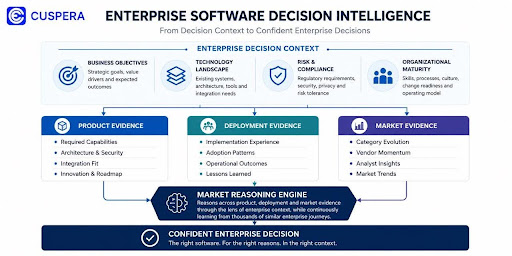
Across thousands of enterprise software evaluations, we observed a consistent pattern: successful decisions depend not on having more information, but on interpreting it within the right decision context. Every enterprise approaches a software decision with its own business objectives, technology landscape, organizational maturity, regulatory obligations, investment priorities, and tolerance for risk. Collectively, these factors define the Decision Context that makes every enterprise software decision unique.
At Cuspera, we found that once an enterprise’s Decision Context is understood, three complementary evidence systems become essential to making a confident software decision.
Product Evidence answers whether a solution can technically deliver the required capabilities, integrate with the existing technology landscape, satisfy architectural and security requirements, and support future business needs.
Deployment Evidence explains how the software has performed in real enterprise environments implementation experience, adoption patterns, operational outcomes, and the lessons learned from organizations that have already navigated similar journeys. Market Evidence provides the strategic perspective: category evolution, competitive positioning, vendor momentum, analyst insights, and the broader technology trends that influence whether today’s decision will remain the right one tomorrow.
CUSPERA PERSPECTIVE – ENTERPRISE TECHNOLOGY
Enterprise software decisions become significantly more reliable when these evidence systems are reasoned together through the lens of an enterprise’s unique Decision Context. Reasoning consistently across these evidence systems and learning from thousands of similar enterprise decisions is beyond what traditional software discovery tools were designed to do.
Consider two enterprises evaluating the same AI-powered customer support platform. The Product Evidence is identical: AI-assisted ticket summarization, automated response drafting, and intelligent routing. Yet their Decision Context is very different. One has a modern CRM and can invest in a longer integration for greater long-term flexibility. The other operates under strict regulatory constraints, relies on legacy systems, and needs rapid deployment. The product hasn’t changed. The evidence hasn’t changed. The Decision Context has and so has the right decision.
This insight became the foundation for Cuspera’s Market Reasoning Engine, which reasons across these evidence systems, while continuously learning from similar enterprise decision journeys. Rather than simply identifying products that match a set of requirements, it enables enterprises to benefit from the collective experience of organizations that have faced comparable business and technology challenges helping explain which solutions are most likely to succeed in a specific enterprise context, and why.
We believe this next phase is Enterprise Software Decision Intelligence, the ability to combine enterprise context, multiple forms of evidence, and knowledge derived from similar enterprise journeys to help organizations make better software decisions. As AI continues to reshape both software development and software evaluation, competitive advantage will come not from knowing more, but from reasoning better. That belief continues to shape how we are building Cuspera.