

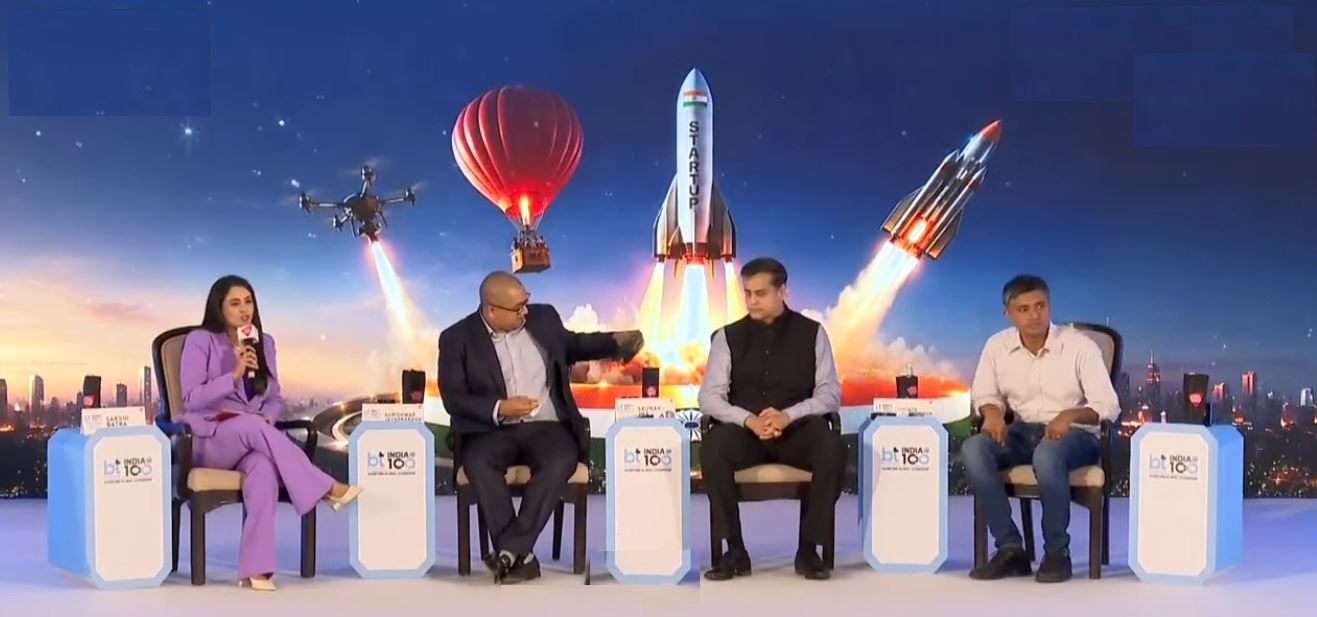
India’s space ambitions are entering a new phase as private companies increasingly move beyond supplying components and supporting the national space programme to developing rockets, satellites, propulsion systems, drones and other advanced technologies.
The transformation of the country’s space sector has accelerated since the government opened the industry to greater private participation. From a handful of startups a few years ago, India now has more than 400 space startups working across launch vehicles, satellite manufacturing, propulsion, space electronics, data services and other emerging areas.
The momentum was underlined by Prime Minister Narendra Modi’s recent interaction with the founders and CEOs of 20 Indian space startups. The meeting brought together companies including Skyroot Aerospace, Agnikul Cosmos, Pixxel, Dhruva Space, GalaxEye, PierSight, Bellatrix Aerospace and Digantara.
The Prime Minister urged space entrepreneurs to expand the application of space technology beyond traditional missions and explore solutions for agriculture, livestock, the environment and other sectors that can directly improve people’s lives.
From ISRO support to end-to-end capabilities
India’s private space companies are gradually taking on a larger role in the complete space ecosystem.
The industry is witnessing the development of privately built launch vehicles, satellites, propulsion technologies, earth-observation systems and space-surveillance capabilities. The successful progress of companies such as Skyroot Aerospace and Agnikul Cosmos has demonstrated that Indian startups can develop sophisticated launch technologies outside the traditional government-led model.
However, industry leaders say developing a prototype is only the beginning.
For deep-tech companies, the bigger challenge is moving from laboratory development to repeated testing, certification, manufacturing and commercial deployment. This requires specialised infrastructure and long-term capital.
Testing facilities are particularly important for advanced propulsion and aerospace technologies. Companies developing sophisticated engines and other deep-tech systems cannot depend entirely on limited national facilities if India wants to accelerate innovation and compete globally.
The government as an anchor customer
One of the key issues facing India’s deep-tech ecosystem is the transition from development to commercialisation.
Industry experts argue that government agencies can play an important role as early customers for emerging technologies. Instead of waiting for a fully mature product, government procurement programmes could support technologies once they meet defined performance thresholds.
Such early orders would allow companies to test their products in real-world conditions, generate revenue and improve their technologies through successive development cycles.
For startups working on defence, aerospace and other strategic technologies, this could be crucial in overcoming the so-called “valley of death” between research and commercial scale.
Capital remains a critical challenge
Building rockets, propulsion systems and space infrastructure requires considerably more capital and time than conventional technology businesses.
India has seen a sharp increase in private investment in space startups, with cumulative investment in the sector reaching hundreds of millions of dollars. But entrepreneurs say the industry still needs patient capital capable of supporting companies through long development and testing cycles.
Investors also need a greater understanding of deep technology, industry leaders argue. Spending on testing facilities, specialised machinery and manufacturing infrastructure may not immediately translate into revenue, but such investments can be essential for reducing technological risk and achieving future commercial scale.
The challenge for founders is equally significant: companies must demonstrate strong unit economics, build commercially viable products and prove that customers are willing to pay for their technology.
Drones offer a blueprint for scale
The transformation is not limited to rockets and satellites.
India’s drone industry is expanding into precision agriculture, mining, infrastructure inspection, oil and gas, surveillance and industrial automation. Advanced sensors, cameras, lasers and other payloads are allowing drones to perform increasingly sophisticated tasks.
The experience of Indian drone companies also highlights an important opportunity: using India as a large-scale testing and deployment market before taking proven technologies overseas.
Indian companies are increasingly looking at international markets where solutions developed for domestic customers can be adapted for industries across the United States, Europe, Africa, Australia and the Middle East.
Making space launches more affordable
Cost competitiveness remains one of the biggest challenges for India’s space ambitions.
Recent studies have highlighted a significant gap between the cost of Indian and US rocket launches. Lowering that gap will require technological innovation, higher launch volumes and greater use of reusable systems.
Reusable rockets could fundamentally change the economics of space launches by allowing expensive hardware to be used multiple times instead of being discarded after every mission.
India’s geographical position also offers advantages for certain orbital missions. Its relatively low latitude and long coastline provide favourable conditions for a range of launches, although different missions and orbital requirements can demand different launch locations.
The next generation of Indian space companies is therefore looking beyond simply launching from India. The ability to adapt launch systems to the requirements of international customers could become an important competitive advantage.
Propulsion: The next major frontier
Advanced propulsion is another area where India is seeking greater technological independence.
Developing high-performance jet engines, rocket engines and next-generation propulsion systems requires years of research, specialised manufacturing and extensive testing.
Industry leaders believe India already possesses a strong manufacturing base capable of supporting much more sophisticated aerospace development. What is needed is greater investment in dedicated testing infrastructure and the ability to use those facilities across multiple technology programmes.