

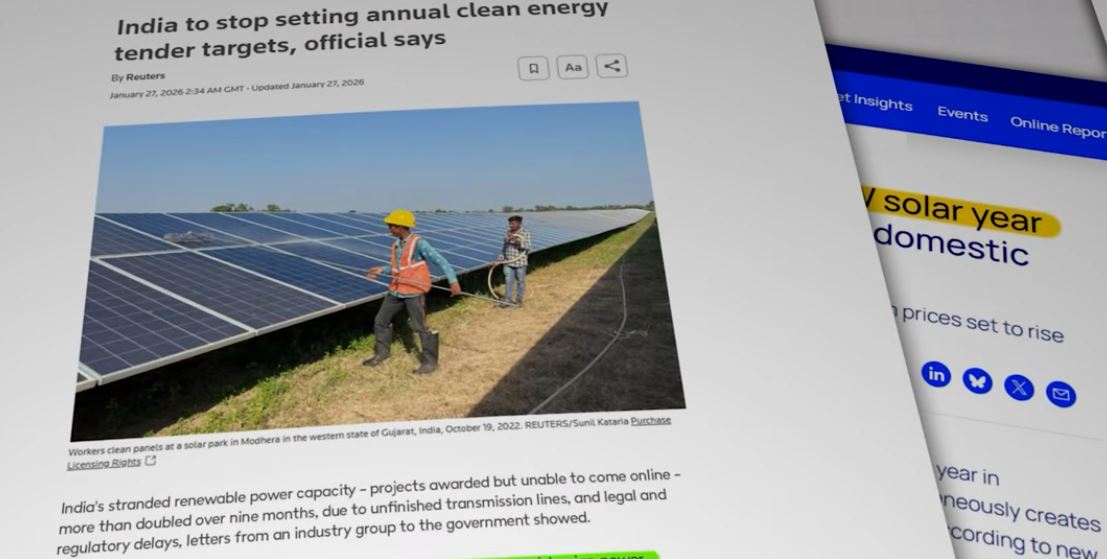
India is witnessing a major transformation in its energy sector as the country rapidly expands solar power while continuing to depend on coal to meet surging electricity demand.
The transition presents a unique challenge for the world’s most populous country. India needs enormous amounts of new electricity to support industrialisation, urbanisation and rising living standards, while simultaneously attempting to reduce the carbon intensity of its power sector.
Unlike China’s coal-heavy industrial expansion over the past three decades, India is increasingly turning to solar and other renewable sources to supply a large share of its new electricity needs.
Solar Power Emerges as a Major Growth Engine
India’s solar sector has expanded at remarkable speed.
The country had around 100 gigawatts of installed solar capacity at the end of 2024. By March 2026, capacity had crossed 150 GW, while government figures put the total at nearly 165 GW by July 2026.
The rapid expansion reflects India’s growing investment in renewable energy and the falling cost of solar technology.
Industry analysts expect the growth to continue, with forecasts suggesting that India could install more than 50 GW of additional solar capacity in 2026.
The broader clean-energy mix is also expanding. Solar, wind, hydropower and nuclear power are collectively becoming increasingly important sources of electricity, although fossil fuels still provide the majority of India’s power.
Rising Demand Complicates the Transition
India’s energy story cannot be measured simply by the percentage of electricity currently generated from renewable sources.
Electricity demand is rising rapidly as the economy expands.
The International Energy Agency expects India’s electricity demand to grow by around 6.5% annually through 2030, driven by manufacturing, urbanisation, increasing household consumption, air-conditioning demand, electric vehicles and the expansion of data centres.
The country could add almost 700 terawatt-hours of annual electricity consumption by 2030, creating a massive requirement for new generation capacity.
This makes one question particularly important: How will India meet its future electricity demand?
The answer could increasingly be solar.
The IEA expects solar power to provide roughly half of the increase in India’s electricity demand between now and 2030. Wind, hydropower and nuclear energy are also expected to contribute to the expansion.
If those projections materialise, a majority of India’s additional electricity could come from low- or zero-carbon sources.
Falling Costs Strengthen Solar’s Position
Economics is playing a crucial role in India’s renewable-energy expansion.
The country has some of the world’s strongest solar resources, particularly in states such as Rajasthan and Gujarat. Large areas of relatively inexpensive land also provide opportunities for utility-scale projects.
At the same time, global manufacturing has driven down the cost of solar photovoltaic modules.
India is also developing its own solar manufacturing industry as it seeks greater energy security and reduced dependence on imports.
The combination of abundant sunlight, declining technology costs and expanding domestic manufacturing is strengthening the economic case for solar power.
Batteries Could Reduce Coal’s Balancing Role
Energy storage is another factor reshaping the outlook.
One of the traditional challenges with solar power is that generation falls after sunset, precisely when electricity demand can remain high. Battery storage can help bridge that gap by storing surplus electricity generated during the day and releasing it when required.
Developers are increasingly considering projects that combine solar, wind and battery storage, rather than relying solely on standalone renewable generation.
As battery costs decline, such systems could provide more reliable renewable electricity and gradually reduce the need for coal plants to compensate for fluctuations in solar generation.
Grid Infrastructure Remains a Major Hurdle
However, India’s clean-energy ambitions face a significant infrastructure challenge.
Many of the country’s best renewable-energy resources are located far from its largest centres of electricity demand. Moving that electricity across the country requires extensive transmission infrastructure.
The timing creates an additional problem. Solar plants can be constructed relatively quickly, while large transmission projects can take considerably longer to plan, approve and complete.
The resulting mismatch has already contributed to delays in renewable-energy projects.
Reports have indicated that tens of gigawatts of renewable projects have faced difficulties related to transmission availability, power purchase agreements and grid connections.
India’s decision to reconsider its previous target of tendering 50 GW of renewable projects annually has also highlighted the difficulties of rapidly adding generation capacity without sufficient infrastructure and buyers.
Coal Still Has a Role
Despite the rapid expansion of renewable energy, coal remains firmly embedded in India’s electricity system.
The IEA expects coal-fired generation to continue growing through the end of this decade because electricity demand is increasing so quickly.
However, coal’s share of the electricity mix could decline even while the absolute amount of coal-fired generation rises.
Projections suggest coal could fall from roughly 70% of India’s electricity generation today to around 60% by the end of the decade.
That distinction is important. India’s transition is not currently a simple replacement of coal plants with solar farms.
Instead, renewable energy is increasingly meeting a large portion of the country’s incremental electricity demand, while coal continues to support the existing power system.
Could Solar Eventually Overtake Coal?
The rapid growth of solar raises an important long-term possibility: could solar become India’s largest source of electricity?
Some projections indicate that solar could overtake coal during the second half of the 2030s, although the timing will depend on how quickly India can expand its grid, storage capacity and renewable-energy infrastructure.
The trajectory will also depend on electricity demand, government policy, investment and the continued decline in clean-energy costs.
For now, describing India’s transition as a straightforward move “from coal to solar” would be premature.
Coal remains essential to meeting today’s demand. Solar, meanwhile, is increasingly shaping how India plans to meet tomorrow’s demand.
A Different Industrialisation Model
The stakes extend well beyond India’s borders.
India’s per-capita electricity consumption remains significantly below that of China, Europe and the United States. As incomes rise and industrial activity expands, the country’s electricity consumption is expected to increase substantially.
If India were to follow China’s earlier coal-intensive development model, the implications for global carbon emissions could be significant.
But India’s growing reliance on solar, wind, hydropower, nuclear energy and battery storage offers the possibility of a different path.
The country still faces enormous challenges, including grid expansion, project delays, regulatory hurdles and continued dependence on coal. Yet the rapid growth of solar demonstrates that economic development does not necessarily have to follow the same fossil-fuel-intensive trajectory experienced by earlier industrial powers.
India is not abandoning coal but it is increasingly building its future electricity system around the sun.
The success of that transition could have profound implications not only for India’s economy and emissions, but also for the future direction of global energy.