

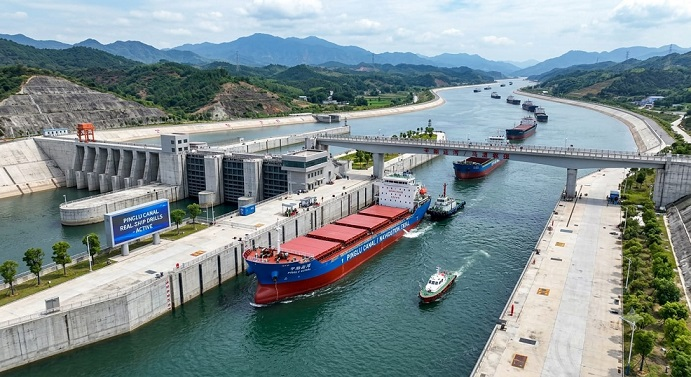
The historic Pinglu Canal project in southern China has entered its critical final evaluation phase, with comprehensive real-ship navigation exercises now underway along the entire 134.2-kilometer corridor. The drills mark the final testing threshold before the multibillion-dollar engineering marvel opens to commercial maritime traffic.
Spanning from the Xijin reservoir area in Hengzhou to the Beibu Gulf near Qinzhou, the canal creates China’s first direct river-to-sea waterway built since the founding of the People’s Republic. Once fully operational, the project will bypass longer historical detours through the Pearl River delta, shaving roughly 560 kilometers off cargo journeys from inland Guangxi to open waters.
The ongoing navigation exercises involve multiple working vessels spanning 1,000-ton, 3,000-ton, and maximum-capacity 5,000-ton bulk carriers running both loaded and empty configurations. Fleet operators and marine authorities are putting the waterway through rigorous trials, including maneuvering through tight bends, simulated overtaking, nocturnal sailing, and navigating under changing tidal dynamics.
Crucial attention is focused on the canal’s three giant navigation hubs at Madao, Qishi, and Qingnian. Engineers are monitoring the behavior of vessels navigating the twin single-step locks, testing water-saving discharge systems, surge mitigation, and vessel stability during significant elevation shifts.
Vessels participating in the exercises are paired with BeiDou satellite positioning, drone-assisted water flow sensors, and stress monitors to evaluate wave patterns, wake impacts on canal embankments, and clearance tolerances between ships. Maritime emergency teams have also staged responses to extreme weather conditions, strong crosswinds, and sudden lock drainage scenarios to confirm comprehensive safety readiness.
With construction progress exceeding 98 percent, the data gathered from these real-ship operations will finalize the canal’s official transit rules and maritime dispatch protocols. The route is slated to serve as a vital maritime artery connecting inland industrial hubs in southwestern China directly to Southeast Asian and global sea lanes.
To explore how the canal’s lock systems manage large vessels through challenging terrain, you can watch How It Moves 5000-Ton Ships Through Mountains. This video explains the engineering principles and hydraulic lock operations designed for the 5,000-ton vessels participating in these trials.