

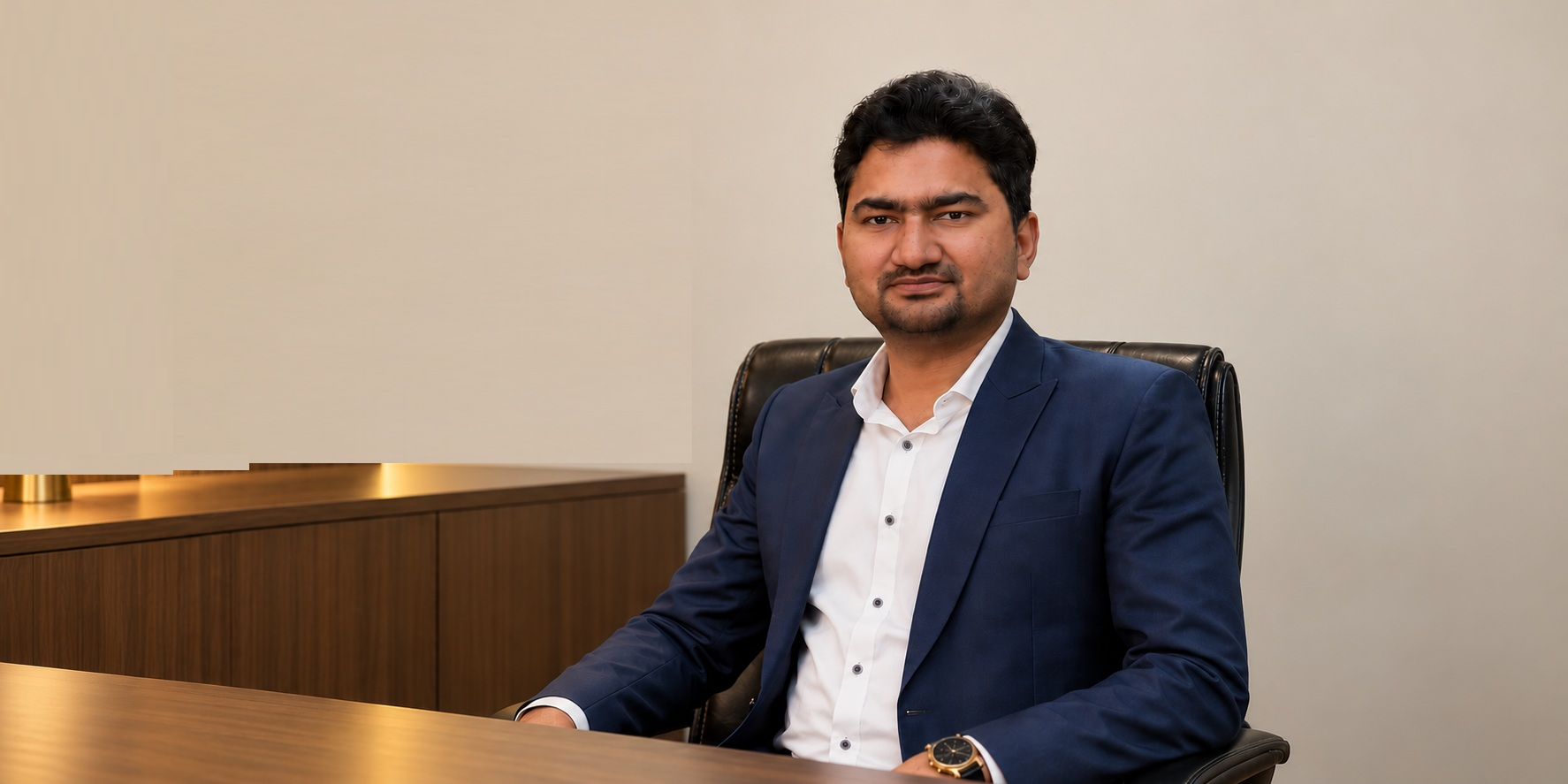
With a portfolio spanning more than 500 projects across residential, commercial, hospitality, healthcare, planning, interiors and landscaping, Ataulla Khan has built Dynamic Architects around a simple yet powerful philosophy: architecture is not just about creating beautiful spaces, but about understanding people, solving problems and delivering meaningful, practical solutions.
From choosing architecture as a career without a family background in the profession to pursuing advanced studies in Healthcare Architecture and Urban & Regional Planning, Khan’s journey reflects a continuous commitment to learning and evolution. Under his leadership, Dynamic Architects has developed a multidisciplinary approach that brings architecture, interiors, planning and engineering together.
In this conversation, Ataulla Khan reflects on his professional journey, the lessons learned from 500+ projects, the importance of client trust, the balance between creativity and technical practicality, and his vision for taking Dynamic Architects into a more technology-driven future through BIM, Virtual Reality and emerging digital tools.
Interviewer: Can you briefly share your journey in architecture and what inspired you to establish Dynamic Architects?
Ataulla Khan: I chose architecture not by chance, but by choice. Since I did not come from a family background in architecture or construction, I initially explored the difference between Civil Engineering and Architecture before making my decision. After some research and self-assessment, I found myself better suited to architecture, both in terms of my interests and the way I think.
I pursued my B.Arch. from NIT Patna, followed by an M.Arch. in Healthcare Architecture from Jamia Millia Islamia (JMI), New Delhi. Before establishing myself professionally in Lucknow, I also gained some experience as a Visiting Faculty, which gave me valuable exposure to teaching and academic interaction.
At the same time, I wanted to develop a better understanding of cities and urban development at a broader level. This led me to pursue a Master’s Degree in Urban & Regional Planning from Government College of Architecture, Lucknow (AKTU).
Architecture and Urban Planning are professional disciplines where formal education provides the foundation, but the real learning continues throughout one’s professional life. You gain experience from different institutions, projects and people, but there is always an aspiration to establish your own practice to express your ideas independently and bring them to the ground in a meaningful way.
I often feel that architecture is, in a way, similar to medicine. You keep practising, learning and evolving throughout your professional life. That continuous learning is one of the things that makes this profession so interesting to me.
The establishment of Dynamic Architects came from this aspiration to create a practice where architecture, planning, interiors, engineering and practical understanding could come together to provide meaningful and comprehensive solutions to clients.
Interviewer: Dynamic Architects has completed 500+ projects across different sectors. What has been the biggest learning from this journey?
Ataulla Khan: We are certainly proud of completing 500+ projects, but more than that, we are genuinely thankful to our clients who placed their trust in us. Their confidence in our work has always been one of our biggest motivations, and we have tried to reciprocate that trust with sincerity, hard work and commitment.
One thing that has remained constant throughout our journey is the level of interest with which we discuss a project with a client at the beginning. The same interest and involvement continues until the very last day of project delivery. For us, a project is not merely a professional assignment; it is a responsibility.
Over the years, we have had the opportunity to work across diverse sectors, including Residential, Commercial, Hospitality, Healthcare, Planning, Interiors and Landscaping, among others. Every sector and every project has added something to our experience.
However, perhaps the biggest learning has been that no project is small or big when you consider the emotions and aspirations attached to it. A project may be limited in physical scale or volume, but the spirit behind it can be enormous.
For a middle-class family, their home may represent their life’s savings and their dream of building a better future. Understanding that emotional value is extremely important for an architect.
We have also learned that you never really know which project will connect you to the next opportunity or how one satisfied client can lead you to another. Over time, this creates a strong chain of relationships built on trust and the quality of your work.
With experience, you may become more selective about the projects you take up, but that selectiveness should come from confidence in your work, your effort and your ability to deliver, rather than simply from the size or scale of a project.
Interviewer: Your practice combines architecture, interiors, planning and engineering. How does this multidisciplinary approach shape your projects?
Ataulla Khan: For us, a multidisciplinary approach is not simply about offering multiple services under one roof. It is more importantly about better leadership, coordination and teamwork.
When architecture, interiors, planning and engineering are considered together, our clients feel much more comfortable because different aspects of their project are being addressed by a coordinated professional team. It also enables us to identify and resolve many technical and practical issues much earlier in the design process.
At the same time, working across different disciplines continuously expands our own knowledge. Every project, every sector and every client interaction contributes to our collective experience.
Over time, we have seen that good projects and good clients help build a better team, and a better team, in turn, helps create and deliver better projects.
Ultimately, a company is its team, and a strong team strengthens the company. This continuous cycle of learning, collaboration and improvement is what helps us move forward.
Interviewer: With projects across residential, commercial and institutional spaces, how do you adapt your design thinking to different requirements and contexts?
Ataulla Khan: For us, design is not simply about creating something visually attractive. Design is a problem-solving process, but it also has a spirit, a soul and the ability to create an overall ambience.
We begin by understanding the specific requirements of a project and actively involve the client in the planning process. Along with the client’s brief, several other factors need to be considered, including statutory norms, life safety, climate-responsive design, functional requirements, future expansion, budget, and, where required, considerations such as Vastu.
The challenge is to bring all these factors together and arrive at a balanced solution. That solution is then translated into drawings and technical documents.
In architecture, drawings are essentially our language at the site. They communicate the design intent to everyone involved in the execution process.
Every project has its own context, requirements and constraints. Therefore, an architect needs to immerse themselves in the project and understand it deeply before arriving at a design solution. The better you understand the project, the better the design outcome can be.
Interviewer: How do you balance creative design with technical practicality, functionality and long-term value for clients?
Ataulla Khan: I believe that balance is what ultimately makes you a better designer. A designer needs to develop a balanced and holistic approach neither unnecessarily excessive nor inadequate.
Creative design, technical practicality, functionality and long-term value cannot be treated as separate objectives. They need to work together. At the same time, achieving this balance within the client’s budget is certainly a challenge and an important part of our professional responsibility.
I also believe that a design problem does not necessarily have only one correct solution. Unlike mathematics, where a problem may lead to a defined answer, a design problem can have multiple solutions, and several of them may be equally valid depending on the aspects being considered.
The role of a designer is therefore to understand these possibilities and arrive at the solution that creates the best overall balance between aesthetics, functionality, technical feasibility, cost and long-term value.
Interviewer: What is your vision for Dynamic Architects over the next few years, and what new directions would you like the practice to explore?
Ataulla Khan: Over the coming years, our vision is to take Dynamic Architects to a much larger professional circle while continuing to strengthen the quality and depth of our services.
We have a hardworking team, and one of our strengths is our ability to adapt quickly to technological advancements. We believe technology should not replace design thinking; rather, it should empower architects and teams to work smarter, communicate better and deliver better solutions.
Our aim is to build a strong professional team by attracting and retaining smart and capable employees, while providing them with better opportunities for professional growth. At the same time, we want to offer our clients the best possible consultancy services and strengthen our capabilities as a one-stop professional solution for architecture, planning, interiors and engineering requirements.
Technology will play an increasingly important role in this journey. We are particularly interested in areas such as BIM implementation, Virtual Reality and other emerging digital technologies that can improve design coordination, visualization, client communication and project delivery.
Ultimately, our vision is not simply to become bigger. It is to become better, smarter and more capable, while maintaining the trust of our clients and continuing to evolve the design values that have shaped Dynamic Architects.