

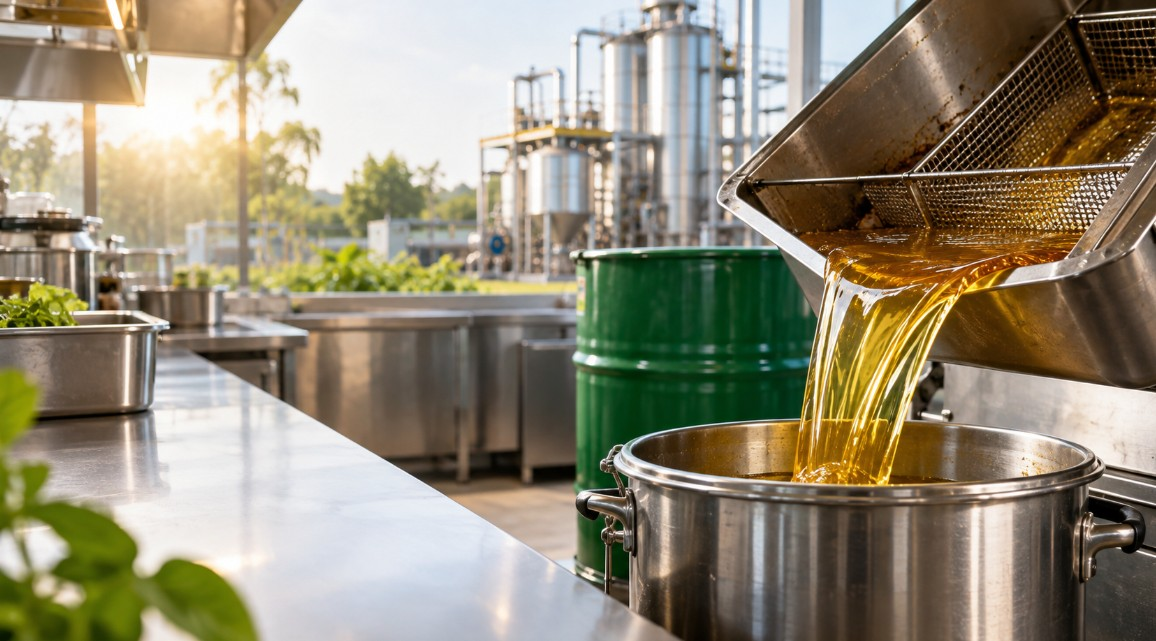
India’s growing food-service sector is creating a major opportunity for the used cooking oil recycling industry, as restaurants, hotels, cloud kitchens, caterers and households look for safer ways to dispose of oil after frying.
Used cooking oil, commonly called UCO, has traditionally been discarded into drains, mixed with general waste or, in some cases, re-entered the food chain through informal channels. However, a more organised collection-and-recycling ecosystem is now emerging, designed to divert this waste from unsafe reuse and convert it into biodiesel.
Ecoil is among the companies working in this space, offering collection services for used cooking oil from households and food businesses. The company says the collected oil is channelled for conversion into biodiesel, creating a waste-to-energy pathway while encouraging businesses to adopt more responsible disposal practices.
The sector is closely linked to food safety. The Food Safety and Standards Authority of India (FSSAI) has fixed a maximum limit of 25% for Total Polar Compounds in cooking oil. Once oil crosses this threshold, it should not be used further for food preparation. Repeatedly heated oil can degrade in quality, making monitoring and safe disposal important for food businesses that rely heavily on frying.
To address this issue, FSSAI introduced its Repurpose Used Cooking Oil, or RUCO, initiative. The programme aims to build an ecosystem in which used cooking oil is collected from food business operators and repurposed into biodiesel rather than being reused for cooking or released into the environment.
For the industry, the key challenge is not only recycling capacity but also collection. Unlike large industrial waste streams, used cooking oil is generated in small quantities across thousands of kitchens. Restaurants, roadside eateries, bakeries, hotels, housing societies and homes all produce UCO, but collection becomes viable only when businesses have reliable pickup systems, storage support and clear financial incentives.
This is where digital collection networks are beginning to play a larger role. Ecoil states that it connects oil generators with collectors and recycling partners, helping organise pickups and route the collected material into authorised recycling channels. Such models can make the process more traceable for food businesses while reducing the operational burden of disposing of used oil responsibly.
The environmental case is also significant. Cooking oil poured into drains can contribute to clogged sewage systems and water pollution. When collected separately, however, it can become feedstock for biodiesel production. Biodiesel derived from waste oil is increasingly viewed as a practical circular-economy solution because it gives a second life to a material that would otherwise be discarded.
For restaurants and commercial kitchens, the shift can bring multiple benefits. It supports food-safety compliance, reduces the risk of unsafe oil reuse, improves waste-management practices and may generate a small additional revenue stream depending on collection volumes and local pricing. For households and housing societies, the model offers a more structured alternative to disposing of oil through kitchen sinks or municipal waste.
India’s used cooking oil industry is still developing, but awareness is expanding alongside regulatory attention and demand for cleaner fuel alternatives. The next phase of growth is likely to depend on stronger participation from food businesses, more city-level collection infrastructure and greater public understanding of why used oil should be treated as a recoverable resource rather than ordinary waste.
As organised players such as Ecoil expand collection networks, used cooking oil may increasingly become part of India’s larger transition towards resource recovery, cleaner waste systems and biofuel-led sustainability.