

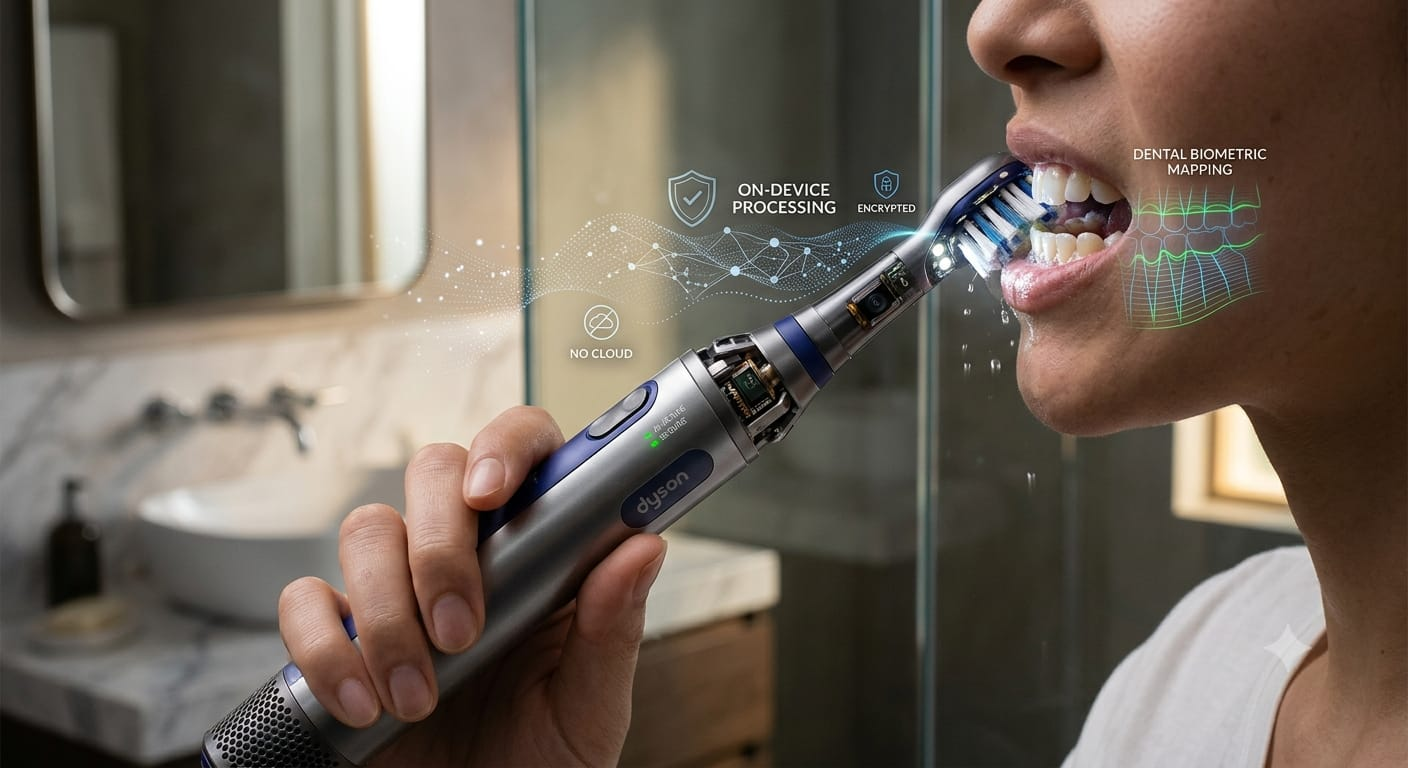
The domestic bathroom has long remained the final frontier of consumer data privacy, a private domestic zone largely spared from the sensors, microphones, and lenses saturating modern living rooms and kitchens. That boundary is dissolving as high-tech oral care enters the consumer market. With the introduction of camera-equipped, artificial intelligence-powered hygiene hardware like the Dyson CameraJet, a new category of bathroom Internet of Things is moving high-resolution optical sensing directly into the human mouth.
The engineering rationale is functional: traditional mechanical brushing fails to clean the interdental spaces where plaque routinely hardens, leading engineers to deploy miniature endoscopic cameras and machine vision algorithms that detect tooth gaps and deploy targeted liquid floss bursts in real time. Yet placing high-speed optical hardware in an environment where people are routinely unclothed and vulnerable introduces immediate cybersecurity and biometric risks.
Unlike typical smart home gadgets that rely on cloud infrastructure to process incoming visual data, this emerging class of personal care tech is turning to local, on-device computing to keep user information secure.
The Biometrics of a Smile
Dental geometry is not anonymous. In forensic science, unique dental patterns, enamel wear, and orthodontic landmarks serve as primary biometric identifiers. A device capturing dozens of frames per second inside the oral cavity is continuously recording biometric structural profiles alongside accidental background visuals from the bathroom mirror.
If routed through remote cloud servers, these streams could be vulnerable to data interception, server misconfigurations, or third-party subpoenas. Moreover, consumer anxiety surrounding connected bathroom devices is acutely high. The prospect of an IoT hack exposing private morning routines has historically deterred manufacturers from installing lenses in personal grooming appliances.
Edge Computing as a Security Firewall
To bypass this hurdle, hardware designers are leaning into edge computing. By processing video feeds locally on the toothbrush microchip and using transient memory architectures, the camera stream operates strictly in a real-time loop.
Under this local-first model, algorithms parse visual frames, identify tooth contours, trigger cleaning jets, and immediately overwrite the frame buffer in volatile memory. Video data never compiles into an archive, moves to an unencrypted solid-state disk, or uploads to external corporate servers.
Only aggregated, non-biometric numerical metrics such as brushing duration, coverage percentage maps, and replacement-head wear are synced over local wireless networks to companion smartphone apps. The optical telemetry itself vanishes the moment the device shuts off.
The Blueprint for Intimate IoT
The emergence of camera-based dental devices underscores a broader shift across connected hardware. As everyday household appliances evolve into preventative medical diagnostics, sensors will inevitably capture increasingly sensitive physiological data.
Dyson and adjacent hardware innovators are discovering that the technological challenge is only half the equation. Convincing mainstream consumers to invite cameras into private sanctuaries requires verifiable zero-retention data policies. By establishing an architecture where computer vision lives entirely at the edge, the future of bathroom technology will depend on proving that what happens behind the bristles stays strictly between the user and their toothbrush.