

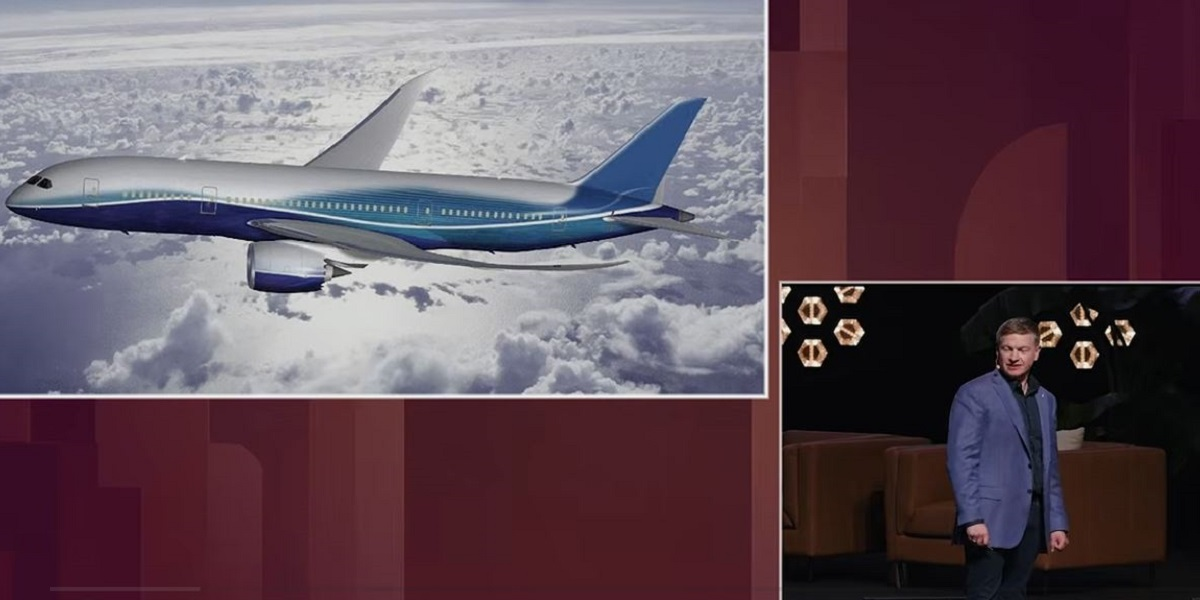
Boom Supersonic CEO and founder Blake Scholl discussed the company’s progress in supersonic aviation, the development of its Overture passenger aircraft, and its broader plans for advanced jet-engine technology during a recent presentation.
Scholl reflected on the long gap in commercial supersonic passenger travel and said Boom Supersonic was established with the goal of making high-speed air travel accessible again. He highlighted the company’s XB-1 demonstrator aircraft, which he said became the first privately developed jet to break the sound barrier in 2025.
According to Scholl, the XB-1 program has also been used to demonstrate the company’s approach to reducing the impact of sonic booms. He described Boom’s technique as “boomless cruise,” which uses atmospheric refraction to redirect the sonic boom upward rather than allowing it to reach the ground.
Developing Overture
The company’s planned commercial aircraft, Overture, is being developed for high-speed passenger travel. Scholl said the aircraft is intended to reach Mach 1.7 over water, while operating at lower supersonic speeds over land where regulations and sonic-boom considerations apply.
During the discussion, Scholl said Boom is targeting a roughly three-hour transatlantic journey at Mach 1.7 and estimated that a round-trip fare of around $3,500 would represent a break-even level for the service. He also indicated that the company is aiming for passenger service around 2030, while noting that the exact timeline depends on the progress of development and testing.
Scholl emphasized that safety, comfort and affordability would be important factors in making supersonic travel commercially viable.
Building its own engine technology
A major part of Boom’s development strategy is its decision to develop its own propulsion technology. Scholl said the company moved toward an internally developed engine after ending its previous relationship with Rolls-Royce.
The company is pursuing vertical integration across engine development and manufacturing, including components such as turbine blades. Scholl said Boom is building a jet-turbine manufacturing facility designed to produce engines at scale.
He also discussed the potential use of the company’s engine technology outside aviation.
Engine technology for data centers
Boom is developing a ground-based application that adapts its engine technology for electricity generation. Scholl said the system is designed to provide 42 megawatts of behind-the-meter power generation for data centers and can operate without water for cooling in the configuration he described.
He said the company has seen significant demand for this technology and expects its manufacturing operations to expand substantially over the coming years.
A longer-term vision for supersonic aviation
Scholl said Boom’s ambitions extend beyond the initial commercial aircraft. He described a future in which supersonic aircraft could eventually serve commercial passengers as well as private and government aviation markets.
For Boom, the broader objective is to reduce travel times and increase connectivity between cities. Scholl argued that the long-term success of supersonic aviation would come when faster travel becomes sufficiently common that future generations regard today’s conventional flight times as unnecessarily long.
While acknowledging that significant engineering and commercial challenges remain, Scholl said Boom is continuing to work toward bringing a new generation of supersonic passenger aircraft to the market.