

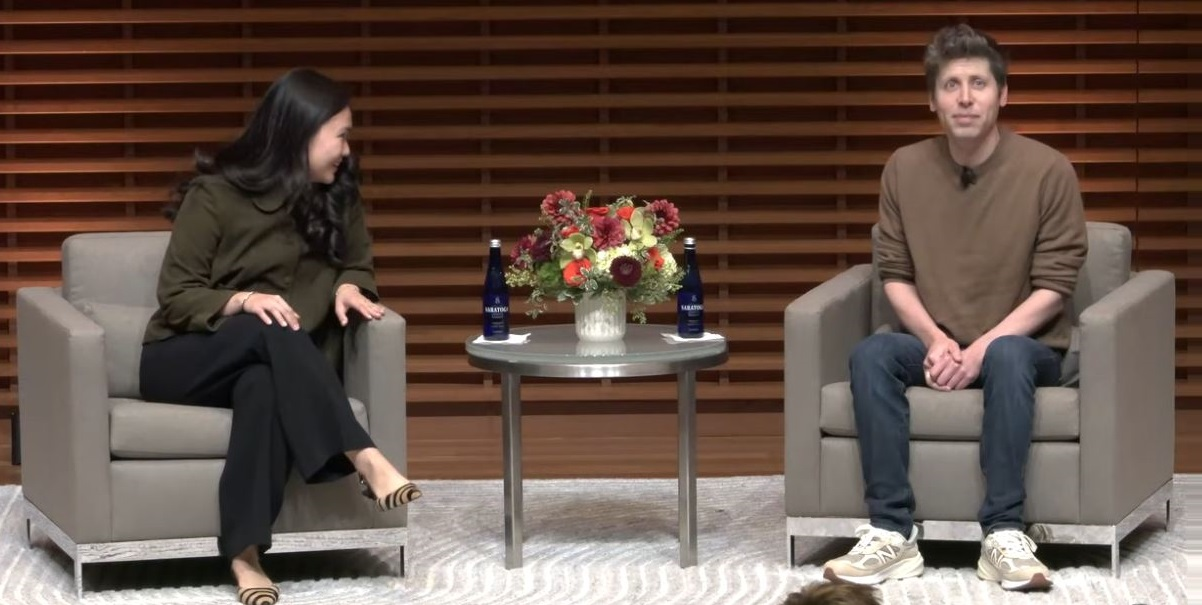
OpenAI CEO Sam Altman says artificial intelligence will transform jobs, accelerate scientific discovery, and reshape businesses, while warning that AI safety and cybersecurity must keep pace with technological progress.
Artificial intelligence is advancing rapidly, raising important questions about the future of work, human potential, and the safe use of technology. Sam Altman, co-founder and CEO of OpenAI, has shared his views on these challenges during a conversation at Stanford Graduate School of Business, highlighting both the opportunities and risks associated with increasingly powerful AI systems.
AI to Transform the Future of Work
Altman believes AI will change the way people work, with many tasks becoming faster, cheaper, and more efficient. Some existing jobs may disappear or change significantly, while new opportunities emerge in industries built around AI technology.
However, he does not expect a complete collapse of employment on the scale sometimes predicted. Instead, he expects substantial changes in the tasks people perform and the skills they need.
Drawing on examples from mathematics, software development, and consulting, Altman explained that even when AI automates parts of a profession, human involvement can remain valuable. Communication, creativity, judgment, and understanding people’s needs may become increasingly important.
He encouraged students and aspiring entrepreneurs to embrace change, develop new skills, and explore opportunities in emerging fields rather than simply following established career paths.
AI Safety and Human Control
As AI systems become more capable, ensuring their safe development and deployment is becoming increasingly important. Altman emphasised that humans must remain in control of the future and that decision-making power should not become concentrated in a small number of people or powerful AI systems.
He argued that society needs to find a practical balance between technological progress and effective safeguards. In his view, neither unrestricted development nor stopping all progress is the right approach.
Altman supports the idea of introducing AI systems gradually while society learns how to manage their capabilities and risks. However, he acknowledged that the speed of recent advances has challenged some of his earlier assumptions about how quickly safety measures would need to evolve.
He also stressed that governments, technology companies, and researchers must work together to establish appropriate standards and safeguards.
Cybersecurity Risks Demand Greater Attention
Altman identified cybersecurity as one of the most serious challenges associated with increasingly powerful AI. He warned that advanced models could discover software vulnerabilities that conventional security methods might fail to detect.
According to his assessment, simply fixing known bugs may no longer be enough as AI systems become more sophisticated. Organisations may need to rethink their cybersecurity strategies and use advanced AI tools to strengthen their digital defences.
He expressed concern that many business leaders and institutions have not fully prepared for the potential scale of these threats.
The challenge, therefore, is not only to develop more capable AI but also to build stronger systems that can protect individuals, businesses, and critical infrastructure.
Human Skills Will Remain Important
Despite AI’s growing capabilities, Altman believes that human values, relationships, and creativity will continue to matter.
He explained that learning should focus on developing skills that help people think clearly, structure ideas, communicate effectively, and solve problems. These abilities can remain valuable even when machines can perform many technical tasks.
Altman also highlighted the importance of human connection. People often value work not only for its outcome but also because another person has contributed effort, understanding, and care.
As AI becomes more widely used, the ability to help others, create meaningful products, and understand human needs may become even more significant.
A New Renaissance Through AI
Altman expressed hope that AI could help create a new renaissance by expanding opportunities for creativity, discovery, and exploration.
Rather than using AI only to automate tasks and maximise economic efficiency, he suggested that society should also focus on helping people gain greater freedom to learn, experiment, and pursue meaningful goals.
Achieving this vision may require businesses, governments, and communities to reconsider how organisations operate and how the benefits of technological progress are distributed.
He also encouraged entrepreneurs to look beyond copying existing AI companies and instead identify new problems that emerging technologies can solve.
Sam Altman’s perspective highlights a central challenge for the AI era: how to benefit from rapid technological progress without compromising security, human control, or individual freedom.
AI has the potential to transform employment, accelerate scientific research, and create new opportunities for innovation. At the same time, its growing capabilities demand serious attention to cybersecurity, alignment, and responsible governance.
The future will depend not only on how powerful AI becomes but also on how people choose to develop, regulate, and use it. Ensuring that AI supports human potential will require continued cooperation between technology companies, governments, researchers, businesses, and society.