

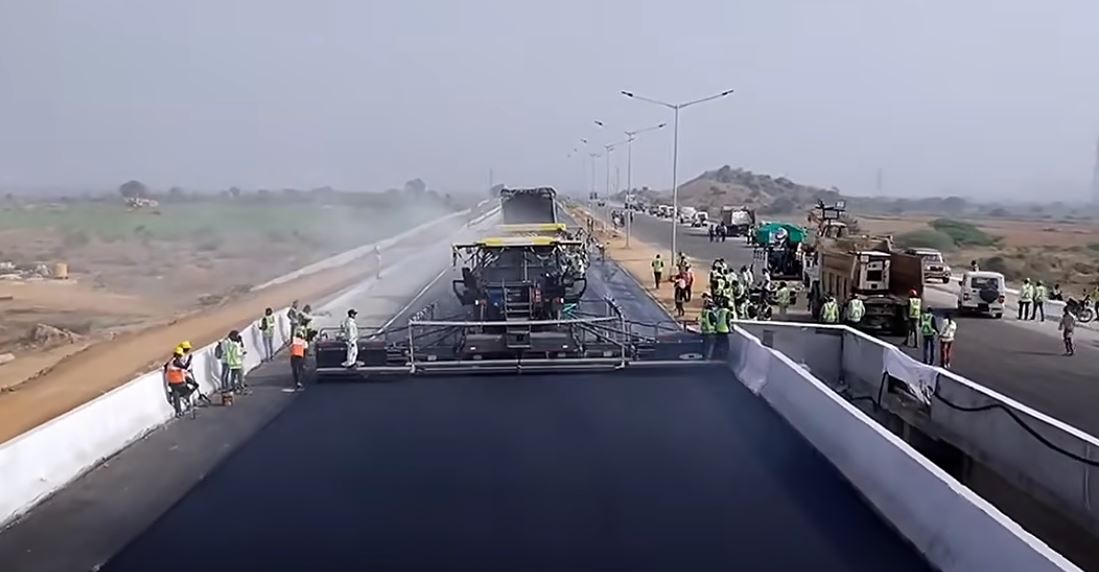
What if industrial waste could become the raw material for the next generation of roads?
That is the idea behind EcoPath Innovations, a Bengaluru-based climate-tech company founded by Sourabh Kumar and Abhishek Chhazed in 2024. The startup is developing cement-free construction materials using industrial by-products and is attempting to change how roads, pavements and other infrastructure are built.
The company says its technology has already been used across several Indian states, with applications ranging from roads and pavers to bricks, blocks and kerbs. A recent profile by NITI Aayog’s Frontier Tech initiative highlighted EcoPath’s zero-cement concrete as an alternative to conventional Portland-cement-based construction.
From Industrial Waste to Construction Material
The basic idea is relatively simple: instead of relying entirely on conventional cement and virgin construction materials, EcoPath uses industrial by-products containing reactive materials such as silica, alumina and calcium.
These materials can otherwise become waste streams from industrial processes.
EcoPath’s technology combines them into a cement-free concrete system designed for construction applications. According to the company, its materials can be used for roads, pavers, blocks, drains and other external infrastructure.
The approach addresses two problems simultaneously industrial waste management and the environmental impact of conventional construction.
Why Cement Is the Bigger Problem
Cement is one of the most widely used construction materials in the world, but manufacturing it has a significant carbon footprint.
Traditional concrete also requires water curing, adding another resource requirement to construction projects.
EcoPath’s alternative aims to remove conventional cement from the mix while reducing the need for water during curing. The company says its technology can reduce carbon emissions by around 75–80% compared with traditional concrete and has already reused more than 10,000 tonnes of industrial waste.
NITI Aayog’s Frontier Tech initiative reports that EcoPath’s technology has avoided more than 715 tonnes of CO₂ emissions over two years and can eliminate water consumption for curing.
The Army School Road That Put the Technology to the Test
One of the company’s notable projects is an internal road at Army Public School in Bengaluru.
EcoPath describes it as a first-of-its-kind road built using zero cement and zero conventional steel. Cement was replaced with ground granulated blast furnace slag, while steel reinforcement was replaced with fibre-based reinforcement bars.
The project was designed not only as an infrastructure project but also as a demonstration that alternative materials could deliver practical performance without relying on conventional cement-based construction.
The company has also worked on projects in Karnataka, Odisha, Tamil Nadu and Maharashtra. NITI Aayog says EcoPath’s technology has been deployed in projects including a cement-free road on MG Road in Bengaluru, an Army school road and an industrial road in Odisha.
A Business Built Around Waste
The opportunity extends beyond environmental benefits.
Industrial waste can become a low-cost input for construction if it can be processed reliably and converted into consistent materials.
That creates the possibility of turning what was previously treated as a disposal problem into a commercial raw material.
EcoPath currently operates multiple manufacturing facilities and produces zero-cement construction products including bricks, blocks, pavers and kerbs. NITI Aayog reports that the company has seven factories, including five in Bengaluru, one in Mysuru and one in Pune.
The company says more than 10,000 tonnes of industrial waste have already been reused through its operations.
From Startup Experiment to Commercial Business
The company is also showing signs of commercial traction.
According to a recent report by NBM Media, EcoPath Innovations’ revenue increased from ₹1.70 crore in FY25 to ₹3.11 crore in FY26, representing an 83% year-on-year increase. The company remained profitable and PAT positive during the period, according to the report.
Its customer base has also expanded beyond experimental projects, with reported work involving developers and infrastructure clients, including Lodha Group and Svamitva Group.
The company’s own website says its solutions are designed to deliver lower carbon emissions, reduced water consumption and longer-lasting infrastructure.
The Bigger Opportunity
The significance of EcoPath’s approach goes beyond one startup.
India needs enormous amounts of infrastructure over the coming decades. Roads, housing, industrial parks, commercial developments and urban infrastructure will continue to require vast quantities of construction materials.
If a portion of that demand can be met using industrial by-products rather than conventional cement-intensive materials, the potential environmental impact could be significant.
The challenge, however, is not simply inventing a greener material. It must also be strong, affordable, scalable and reliable enough for real-world construction.
That is where EcoPath is attempting to position itself.
The company says its road systems can offer longer life and lower maintenance requirements, while its zero-cement concrete is designed to match or exceed conventional performance requirements in several applications.
A New Way to Think About Waste
For decades, industrial waste has largely been viewed as a disposal challenge.
Startups such as EcoPath are attempting to change that equation by treating waste as a resource.
The larger entrepreneurial lesson is equally important: sometimes the biggest opportunities are hidden in problems that other industries are trying to get rid of.
For Kumar and Chhazed, that opportunity lies at the intersection of waste management, construction technology and climate innovation.
If their approach continues to scale, tomorrow’s roads may not simply be built with less environmental damage they could actually turn today’s industrial waste into tomorrow’s infrastructure.
And that could make the humble road a surprising part of India’s transition towards a more circular and low-carbon economy.