

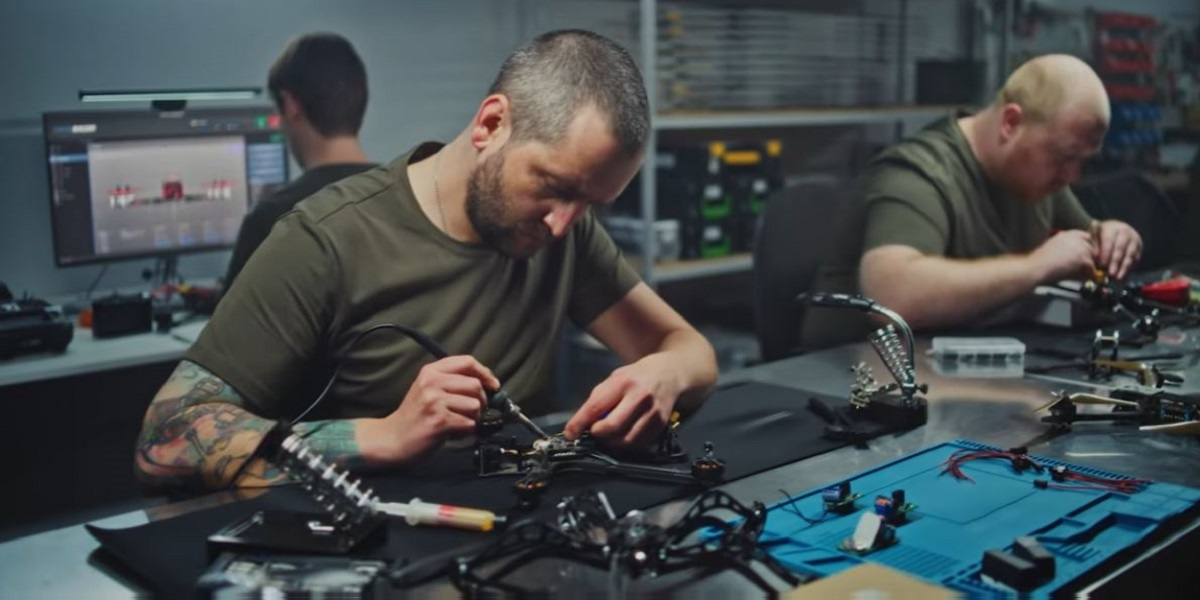
Ukraine’s defense industry has expanded dramatically during the war with Russia, with the country’s projected defense-production capacity reaching $55 billion in 2026, according to Ukraine’s National Security and Defense Council. The figure represents a major increase from the sector’s prewar capacity and highlights the growing importance of defense technology to Ukraine’s economy.
The expansion has been driven particularly by drones, missile systems, unmanned platforms and other technologies developed in response to battlefield requirements. Ukraine has also expanded cooperation with European defense companies, including efforts to establish production outside the country. In February 2026, Ukraine announced that its first Ukrainian drone-production facility in Britain had begun operations.
A $55 Billion Defense Industry
Ukraine’s National Security and Defense Council estimates that the country’s defense-industrial production capacity could reach $55 billion in 2026, up sharply from before Russia’s full-scale invasion. The council says domestic manufacturers supplied more than 70% of Ukraine’s weapons-procurement spending in 2025.
The growth has created a large ecosystem of private and state-linked manufacturers. Drone production has become one of its most visible components, with Ukrainian companies developing FPV drones, interceptor drones and longer-range systems.
The industry is increasingly being viewed not only as a wartime necessity but also as a potential foundation for future economic activity. Analysts at the Center for European Policy Analysis have described defense manufacturing as potentially important to Ukraine’s postwar economic reconstruction.
However, the $55 billion figure represents production capacity rather than $55 billion in actual annual sales or economic output. That distinction is important when assessing the sector’s broader economic impact.
Russia Faces Growing Economic Pressure
Russia’s economy has not “collapsed” in the conventional sense. International forecasts continue to show positive, although weak, economic growth. The IMF’s July 2026 outlook projected Russian growth of around 1.1% for 2026.
At the same time, Russia’s wartime economic model is facing increasing pressure from high military expenditure, labor shortages, inflation and expensive borrowing. Reuters reported in September that Russian businesses and households were dealing with inflation above 6%, high interest rates and a weakening economic outlook.
The Russian government continues to allocate substantial resources to defense and security, supporting parts of the industrial economy while placing pressure on public finances. Recent reporting has highlighted concerns over rising fiscal costs and declining economic momentum.
Ukraine’s Economy Remains Under Severe Strain
Ukraine’s expanding defense industry should not be interpreted as evidence that the wider Ukrainian economy is thriving without qualification. The IMF reported in July that Ukraine’s real GDP grew 1.8% in 2025, down from 3.2% in 2024, and projected growth of only 1%–1.6% in 2026. Continued attacks on energy infrastructure and labor shortages remain significant economic challenges.
At the same time, international financial assistance has helped Ukraine maintain macroeconomic and financial stability. The IMF said Ukraine’s economic resilience has been supported by prudent policymaking and substantial external financing.
Ukraine is also receiving additional European support for its defense needs. On September 18, 2026, Ukraine announced receipt of a €3.3 billion EU loan tranche, with funds directed toward missiles and drones.
A Changing Economic Battlefield
The contrast between the two countries is therefore more complicated than a simple “collapse versus boom” narrative. Ukraine is rapidly building a defense-industrial base while its broader economy remains heavily dependent on international financial support and continues to suffer from wartime destruction.
Russia, meanwhile, continues to maintain economic activity and positive growth but faces mounting pressures from prolonged military spending, inflation, labor shortages and fiscal constraints.
The development of Ukraine’s defense industry could become increasingly significant beyond the battlefield. If production capacity can be converted into sustained orders, investment and eventually international sales, the sector could become an important component of Ukraine’s longer-term industrial recovery. For now, however, the $55 billion figure is best understood as projected defense-production capacity rather than evidence of an economy-wide $55 billion boom.