

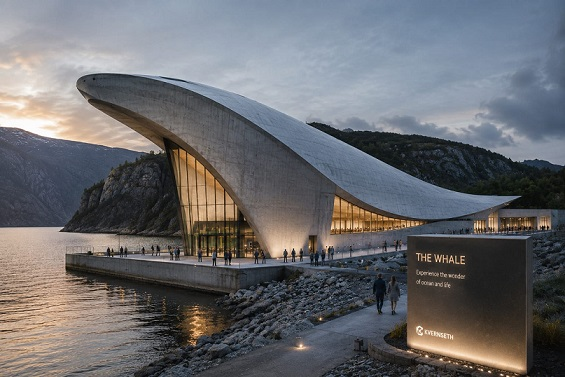
Along the rugged northern coast of Andøya island, roughly 190 miles above the Arctic Circle, a structure is taking shape that looks less like a traditional building and more like an elemental surge of the earth. Known simply as “The Whale,” the international knowledge and experience center is set to open its doors on June 4, 2027, creating a meeting ground where cutting-edge Scandinavian architecture merges directly with marine science.
Designed by the acclaimed Danish architecture firm Dorte Mandrup, the landmark is tailored around its dramatic surroundings. Emerging from the shoreline, the building features an undulating, parabolic concrete shell resembling the tail flukes of a massive whale diving beneath the surface of the Norwegian Sea. Mandrup conceived the structure to blend into the Arctic coastline, describing the design as if a giant had lifted a thin layer of the Earth’s rocky crust and created a sheltered cavity underneath.
The engineering behind the design is as bold as its visual profile. The entire concrete roof touches the ground at only three support points. This creates a vast, column-free interior that spans uninterrupted beneath curving walls of floor-to-ceiling glass looking out across the sea. Outside, the sloped roof is surfaced with local, unworked stones, functioning as a public observation deck where visitors can stand overlooking the archipelago to watch migrating marine life, view the northern lights, or take in the midnight sun.
The location itself is vital to the project’s mission. Andenes borders Bleik Canyon, an underwater trench rich with nutrients that attracts an abundance of marine mammals. The area has long been recognized as one of the premier whale-watching destinations on Earth, drawing sperm whales, humpbacks, orcas, minke whales, and pilot whales close to shore throughout the year.
Inside, the center moves beyond passive display into multisensory education and biological research. The galleries feature life-sized wooden sculptures of individual killer whales identified in local pods, alongside a massive suspended whale installation detailing how cetaceans communicate and coordinate socially. Scientific exhibits explore the evolutionary history of modern whale species, displaying anatomical specimens that include baleen and skeletal structures.
One of the project’s focal points is an immersive soundscape chamber. Designed in near darkness, the space allows guests to experience the infrasonic frequencies of whale communication, sounds so deep they physically vibrate through the human body. Additional exhibits address human history with marine giants, including the legacy of industrial whaling and contemporary conservation issues surrounding shipping lanes and global warming.
By merging site-specific structural design with environmental advocacy, Norway’s upcoming attraction aims to give travelers and marine researchers a shared viewpoint, offering an intimate perspective on some of the largest creatures to inhabit the planet.