

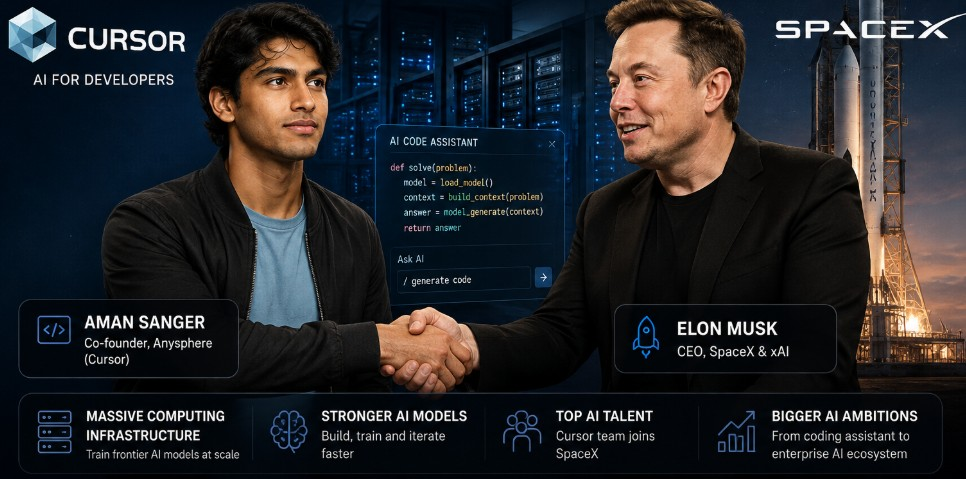
When Aman Sanger and his fellow MIT graduates founded Anysphere in 2022, their ambition was to change how programmers write software. Their flagship product, Cursor, grew rapidly by using artificial intelligence to help developers generate, edit and review code.
Four years later, that startup became part of one of the biggest AI acquisitions to date. SpaceX agreed in June to acquire Anysphere for $60 billion in an all stock transaction, with the transaction subsequently completed in August.
The headline number naturally raises a question: Why would Sanger and his co founders sell such a rapidly growing AI company?
There is no public statement from Sanger establishing a single personal reason for agreeing to the transaction. The available evidence, however, points to one particularly important strategic factor: computing power.
Cursor Had the Product, SpaceX Had the Compute
Training sophisticated artificial intelligence models requires enormous amounts of computing infrastructure, particularly advanced GPUs.
This had become a constraint for Cursor. Reuters reported when the acquisition was announced that the transaction would provide Cursor with additional computing capacity for developing its AI models. At the same time, SpaceX would gain a stronger position in AI coding and enterprise AI through xAI.
That makes the relationship potentially complementary.
Cursor had already built a commercially successful AI product and attracted millions of developers. Forbes reported that developers at companies including Nvidia, Adobe, Uber, Shopify and PayPal use Cursor.
SpaceX, meanwhile, could offer something considerably harder for a startup to obtain independently at scale: massive computing infrastructure.
For an AI company trying to develop increasingly capable proprietary models, access to compute can determine how quickly it can experiment, train models and reduce its reliance on outside AI providers.
A $60 Billion Alternative to Remaining Independent
The financial terms were also difficult to ignore.
SpaceX agreed to pay $60 billion in stock for Anysphere. Forbes estimates that Sanger and each of Cursor’s other three co founders received SpaceX shares worth approximately $2.4 billion when the acquisition closed.
But Cursor was hardly a struggling startup looking for an exit.
Before the deal, the company had experienced extraordinary growth. Forbes reported in June that Cursor had reached a $4 billion annualized revenue run rate, with roughly three quarters coming from business customers.
This makes the decision more interesting. The founders were effectively exchanging ownership of an exceptionally fast growing independent AI company for shares in SpaceX and access to a much larger technology and computing ecosystem.
SpaceX Also Needed Cursor
The transaction was not simply about Cursor needing resources.
SpaceX had its own strategic reason to pursue the company.
AI coding has become one of the areas where generative AI has demonstrated clear commercial demand. Reuters reported that the acquisition was intended to strengthen SpaceX and xAI in enterprise AI tools, particularly coding, where xAI had been competing against companies including OpenAI and Anthropic.
Cursor brought an established developer product, customers, engineering talent and experience in building AI specifically for software development.
SpaceX brought capital, computing infrastructure and the wider xAI ecosystem.
Viewed from that perspective, the transaction looks less like a conventional startup founder simply cashing out and more like an exchange of complementary strengths.
Independence Came With Another Challenge
Cursor also operated in an increasingly difficult competitive environment.
The company relied on models supplied by outside AI companies while simultaneously competing with some of those same companies in AI coding. OpenAI has since announced that it plans to stop providing its models to Cursor following the SpaceX takeover, with access scheduled to end on November 12, 2026. Cursor has said discussions with OpenAI are continuing.
That development illustrates the strategic vulnerability of building an AI application while depending heavily on technology controlled by potential competitors.
Greater access to SpaceX and xAI infrastructure could give Cursor more room to develop its own technology over time.
More Than a Billion Dollar Exit
For Sanger, the acquisition represents an extraordinary financial outcome. But describing the deal purely as a young founder selling his startup for billions misses the larger strategic picture.
Cursor had developers, customers, rapidly growing revenue and valuable AI technology. What it needed to compete at the next level was access to extraordinary amounts of computing capacity.
SpaceX had that infrastructure and wanted a stronger position in AI software.
There is no evidence that computing power was Sanger’s sole personal motivation for selling. But as Cursor attempts to build increasingly powerful AI systems while competing with some of the world’s best funded technology companies, massive compute provides a compelling explanation for why a $60 billion deal with SpaceX could offer more than money.