

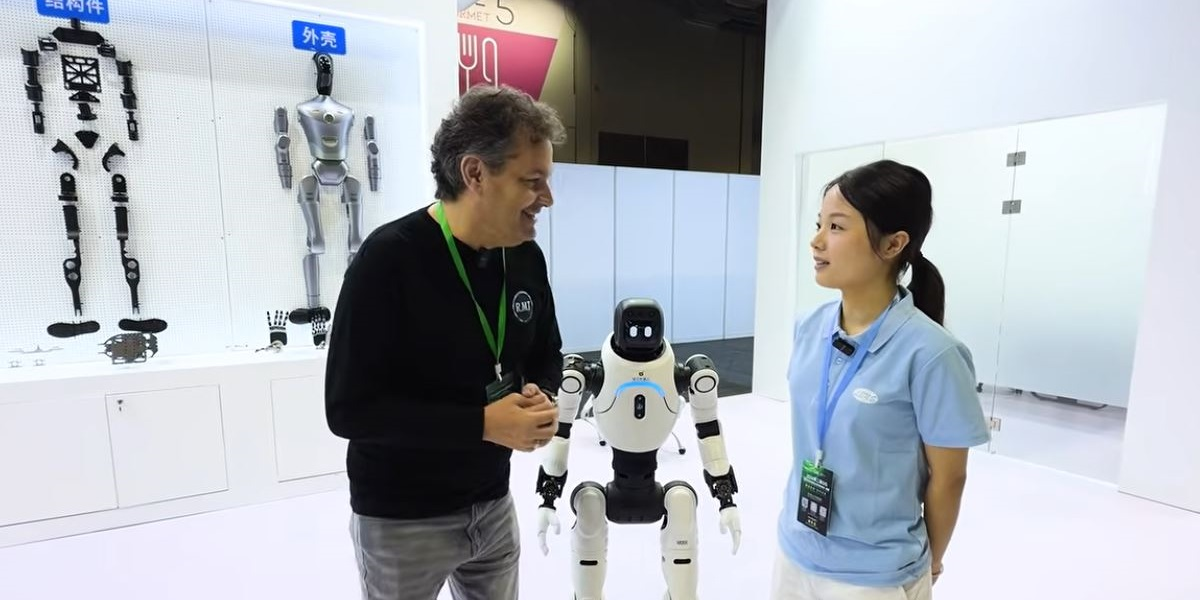
China’s rapidly expanding robotics and artificial intelligence industry is taking center stage at the Global Innovation Summit (GIS) in Hong Kong, where startups and technology companies are showcasing a new generation of intelligent machines designed to interact with people, navigate environments and perform everyday tasks.
The event brings together startups, investors, global buyers and technology companies working across artificial intelligence, robotics, electric vehicles, biotechnology, advanced manufacturing and other emerging fields.
Among the eye-catching technologies on display are humanoid and companion robots, robotic dogs and autonomous patrol systems. Some machines are designed for education and entertainment, while others are being developed for security, property management and industrial applications.
One of the showcased robotic systems is designed to patrol an area autonomously while transmitting live video to a monitoring station. Developers say the technology can help with security and safety applications, with support for multiple languages.
The exhibition also highlights the growing role of AI-powered companion robots. One such product is designed to interact with children and help them learn languages, including English and Mandarin.
Robotic dogs are another major attraction. One compact model, developed by a Shenzhen-based company, is designed for entertainment, companionship and programming. The company said the robot weighs about one kilogram and is expected to retail for around US$800, with a battery life of roughly one hour.
Beyond robots, GIS showcases technologies ranging from 3D-printed footwear to thermal-protection materials for electric-vehicle batteries and energy-storage systems. The wide variety of products reflects how AI and advanced manufacturing are increasingly moving beyond software and into the physical world.
The event also underscores China’s growing presence in several technology sectors. Former Costa Rican President José María Figueres, speaking at the summit, pointed to China’s major role in solar panels, wind turbines, new-energy vehicles, batteries and robotics, while also discussing the country’s growing AI capabilities.
With thousands of professional visitors, hundreds of startup teams and investors attending, GIS aims to connect emerging technologies with potential customers and investment opportunities.
The bigger question, however, is which of these innovations will move beyond the exhibition floor and become commercially successful products.
As AI becomes increasingly embedded in machines that can see, move, communicate and respond to their surroundings, the boundary between traditional machines and human-like technology is becoming increasingly difficult to ignore.