

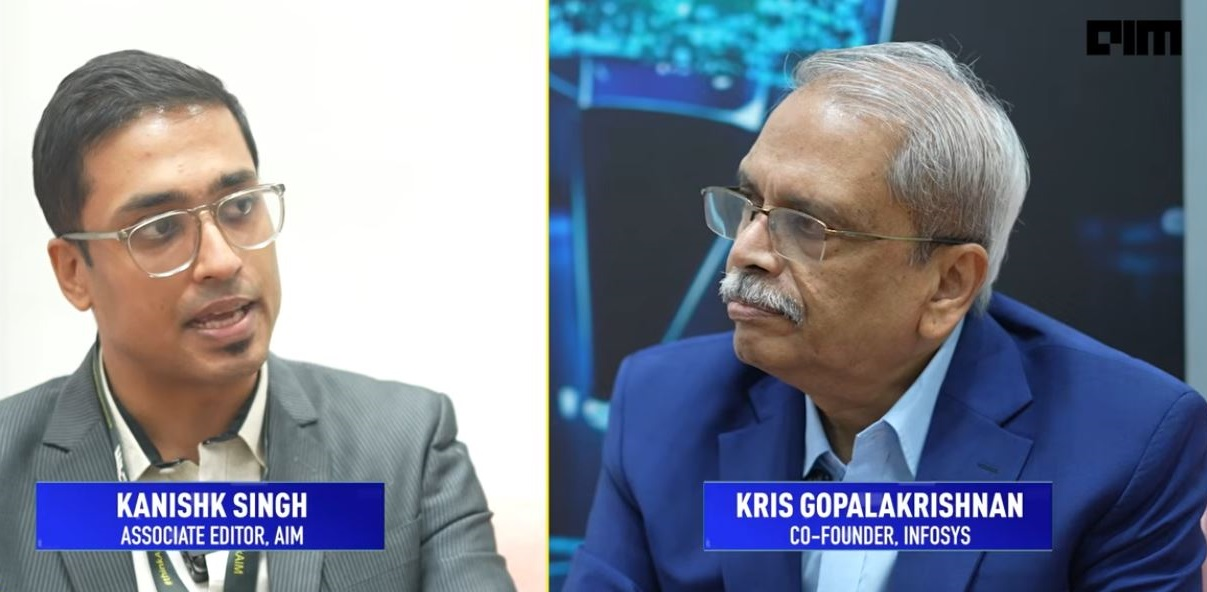
Artificial Intelligence (AI) is set to transform every industry, reshape employment opportunities and redefine the future of India’s technology sector, according to Infosys co-founder Kris Gopalakrishnan. Speaking on the sidelines of the Bengaluru Tech Summit, Gopalakrishnan shared his views on India’s AI ambitions, workforce transformation, responsible AI, infrastructure development and the future of the Indian IT services industry.
Gopalakrishnan, who also chairs committees working with the Karnataka government on AI initiatives, said the adoption of AI is inevitable and that educational institutions, businesses and governments must prepare for an AI-driven future.
Karnataka’s AI University to Focus on Skilling and Research
Discussing Karnataka’s proposed AI University, Gopalakrishnan said the initiative aims to transform education and equip students and professionals with the skills required in an AI-driven economy.
He emphasized that AI must become an integral part of classrooms and that educational curricula across institutions need to evolve. Students should learn how to use AI tools and technologies to solve real-world problems.
The proposed university will initially focus on skilling, certification and diploma programmes through partnerships with industry players and educational institutions. Four memorandums of understanding (MoUs) signed during the Bengaluru Tech Summit are expected to facilitate the training of around two lakh people.
IIIT Bangalore is also establishing an AI hub to train faculty members, students and existing industry professionals. The university is expected to introduce undergraduate, postgraduate and research programmes in the coming years.
Gopalakrishnan said the initiative would bring together the Karnataka government, private industry and academic institutions to build a strong AI ecosystem.
Responsible AI and Data Privacy Take Centre Stage
Highlighting the risks associated with rapidly advancing AI technologies, Gopalakrishnan said the objective of Karnataka’s Responsible AI framework is to ensure that AI is deployed safely, securely and in a privacy-preserving manner.
He stressed that protecting citizens’ personal information must be a priority, particularly when AI is used in sensitive areas such as healthcare, education and public services.
He cited the possibility of personal health information being misused by insurance companies as an example of the privacy risks associated with AI systems.
Gopalakrishnan advocated a techno-legal approach, where regulations are embedded directly into technology and AI systems rather than relying solely on legal provisions.
One proposed approach involves creating secure data spaces in which AI models can work on data without taking the underlying information outside the protected environment.
He said Karnataka aims to develop and test such mechanisms through pilot projects and sandbox environments, with the potential to extend successful initiatives across India.
AI Infrastructure Must Become More Accessible
On India’s AI infrastructure, Gopalakrishnan called for a decentralised approach to expanding access to computing resources, including GPUs and data centres.
Responding to concerns that a significant portion of available GPU capacity remains underutilised while startups struggle to access affordable computing infrastructure, he said there should be multiple initiatives rather than a one-size-fits-all model.
He suggested that state governments, educational institutions, research organisations and private companies should be encouraged to develop their own computing infrastructure.
He also emphasised the need to reduce the cost of AI computing through research into new technologies.
Citing work at the Indian Institute of Science (IISc), he highlighted the potential of analog computing and alternative processor technologies to perform complex computations more efficiently and at lower costs.
AI Will Transform Indian IT, but the Industry Can Continue to Grow
Addressing concerns about AI-driven job losses in India’s IT services industry, Gopalakrishnan expressed optimism about the sector’s long-term growth.
He argued that the fundamental reasons why global companies outsource IT services remain unchanged. Businesses continue to need specialised expertise, access to emerging technologies, industry best practices and the flexibility to scale operations.
According to him, AI will create additional opportunities for IT services companies, particularly in integrating new AI applications with existing enterprise systems and legacy infrastructure.
While AI is already automating certain programming tasks, companies will continue to need professionals for debugging, software integration, data preparation and system maintenance.
He said the industry would experience changes in the nature of work rather than simply a decline in demand.
Drawing comparisons with earlier technology transitions involving the internet, mobile computing and cloud technology, Gopalakrishnan noted that India’s IT industry has expanded significantly over the past three decades.
He expects new opportunities to emerge in AI-powered products, semiconductor development, chip design and advanced manufacturing.
IT Professionals Must Reskill for the AI Era
Gopalakrishnan stressed that every employee in the IT industry will need retraining to remain relevant.
As AI increasingly generates software code, engineers will have to shift their focus towards reviewing, debugging, validating and certifying AI-generated code.
Fresh graduates may face challenges because existing academic curricula have not fully incorporated AI skills. He said finishing schools and industry-led training programmes would play an important role in bridging this gap until educational institutions update their courses.
He also highlighted the importance of training teachers and redesigning curricula to prepare the next generation of technology professionals.
AI Startups and Deep Tech to Drive India’s Next Growth Phase
Speaking about his investment outlook through Axilor Ventures, Gopalakrishnan said the firm is increasingly focusing on deep technology while continuing to invest in other sectors.
He revealed that Axilor Ventures is also operating as a venture studio, creating two to three startups every year.
He said AI adoption would be essential across the firm’s portfolio because of its potential to improve productivity and enable better products and solutions.
Gopalakrishnan also pointed to the growing availability of capital for deep-tech startups, including specialised investment funds and government-backed initiatives such as the ₹1 lakh crore Research, Development and Innovation (RDI) Fund.
He described the current period as an exciting time for entrepreneurs and startups in India.
India’s Technology Future Remains Promising
Despite concerns about market volatility and uncertainty surrounding AI-led disruption, Gopalakrishnan maintained a positive outlook on India’s technology ecosystem.
He acknowledged that technological transitions inevitably create winners and losers, and companies that fail to adapt may struggle to survive.
However, he believes India’s strong IT services base, growing talent pool, expanding startup ecosystem and investments in emerging technologies will create significant opportunities.
His broader message was clear: AI will change the way people work, businesses operate and governments deliver services. The challenge for India will be to ensure that its workforce, institutions and technology ecosystem evolve quickly enough to take advantage of this transformation.