

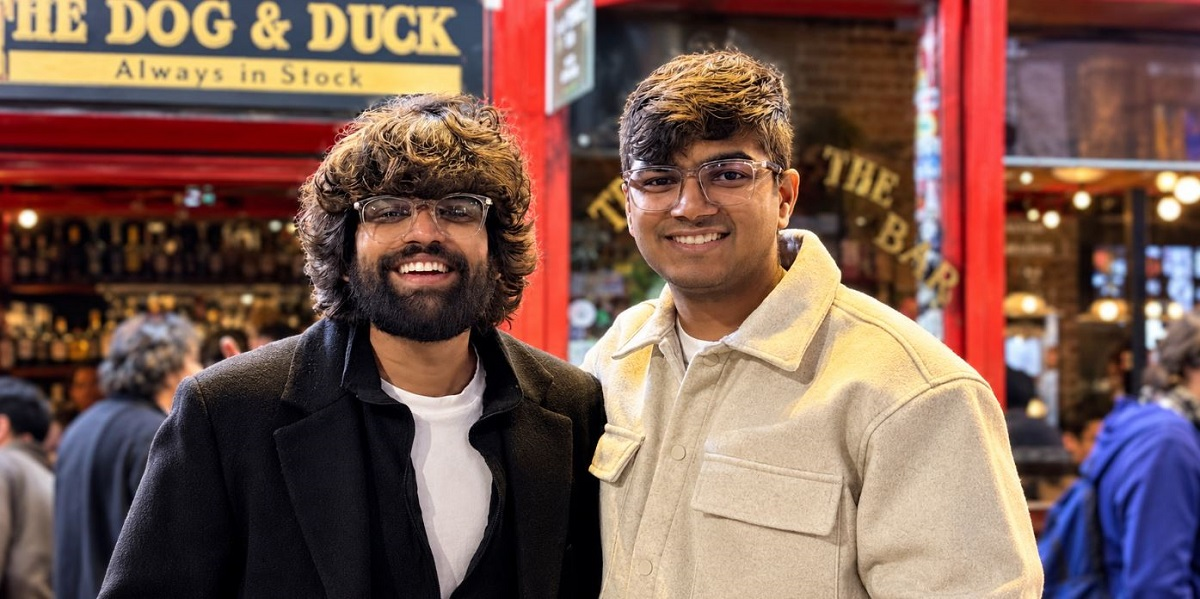
Pragat Pagariya is the co-founders behind DomAiyn Labs, an AI security lab focused on developing safer and more trustworthy AI systems. Pragat Pagariya serves as Co-Founder and CTO, bringing four to five years of experience across AI modelling, computer vision, LiDAR, YOLO, CNNs and RAG models. He holds a Master’s in AI from the National College of Ireland in Dublin and previously worked with organisations including Tata Consultancy Services (TCS) and several MSMEs in India and Dublin. At DomAiyn Labs, his focus is on addressing the technical challenges involved in making AI systems more trustworthy, an approach reflected in the company’s two flagship products, Koala and Bayora. Koala is a command-line interface tool designed for students, developers and coder communities, while Bayora is an enterprise-focused platform for testing AI systems and identifying potential vulnerabilities.
Parth Varshney, Founder and CEO of DomAiyn Labs, has more than seven years of experience across technology, automotive and premium retail. He has worked on campaigns and accounts involving brands such as BMW, Volkswagen, Audi, Coca-Cola and Zara, while also bringing earlier experience in virtual and augmented reality and LiDAR technology. He holds a BBA and an MBA in Marketing, with his professional interests spanning consumer psychology, creative intelligence and understanding human behaviour. Together, Pagariya’s technical focus and Varshney’s experience in marketing, strategy and business development shape DomAiyn Labs’ approach to building and bringing AI safety technologies to market.
Q1. DomAiyn Labs is built around the belief that “intelligence without accountability is a liability.” What led you to focus specifically on AI safety while most companies are focused on making AI more capable?
Parth Varshney:
If you look at the market, even in India, companies are focused heavily on generative capabilities such as text-to-speech and other forms of AI capability. As a whole, the market is chasing capability. DomAiyn Labs has a different vision: we want people to use AI, AI tools, integrations and agents safely.
Your data can be pulled without you knowing it, even after you have closed a tab. Every time you go online, AI can interact with your data, pictures and other information. We believe in making AI use simple, safe and secure, so that people can use these technologies while keeping their information protected.
Pragat Pagariya:
The reason we are focused on AI safety rather than AI capability is that capability is becoming commoditised. Every quarter, someone launches a new model, LLM or agentic AI system, so I don’t think there is a shortage of intelligence anymore.
Most companies are deploying that intelligence and asking it to handle everything that matters to them. The real question for AI safety is: what happens when it all goes wrong, and who takes responsibility for that?
Our entire approach is built around that question. We are taking a stand as an AI trustworthiness and safety platform rather than another company competing on models that are already becoming commoditised.
Q2. Bayora stress-tests AI systems through jailbreaks, instruction overrides and multi-turn manipulation. What are some of the weaknesses you most often discover when AI is pushed beyond its intended use?
Pragat Pagariya:
Finding a model’s weak points through Bayora isn’t the same every time because every system is structured differently. But the pattern we see repeatedly is that systems can break at the trust boundary.
System instructions, user input, retrieved documents and tool outputs can arrive in the same layer, and they cannot all be treated in the same way. That’s where Bayora comes in. We stress-test the entire architecture and identify weaknesses, latency issues, input-classification gaps and other vulnerabilities.
We test system prompts, prompt injection and jailbreaks to understand exactly where a model breaks. Looking ahead, as agentic systems become more compounded, with one agent’s output becoming the next agent’s instruction in a single chain, this is exactly the kind of environment Bayora is built to test.
Parth Varshney:
Most AI interactions are effectively logged as transcripts, and data can eventually flow back into the API or model a company has integrated. The challenge is that small, deliberate prompts can expose places where a model may hallucinate, break or produce a wrong, biased or misleading response.
We call our hardest prompts “zombie prompts” highly adversarial prompts designed to test the limits of a system.
Bayora is an enterprise-grade platform designed to stress-test AI models, identify vulnerabilities and gaps, and provide organisations with evidence of what was discovered during testing.
Q3. Koala uses multiple layers of defence to protect AI systems from potential threats. How did you determine the right balance between strong protection and keeping AI useful?
Pragat Pagariya:
Koala’s layers begin with a checklist of controls around the AI model. We examine the data flow, how data moves between API keys, where cache or session data is stored, the overall architecture, and every point where untrusted content enters the model’s context or where the model touches a real-world trust boundary.
There are five layers in Koala. The first is the ingress layer, covering input classification and structural separation of instructions from data. The second is the retrieval, or RAG, layer, where untrusted content is flagged and sanitised before reaching the model’s context window.
The third is the policy and action layer, covering authorisation and relevant compliance requirements. The fourth is the egress layer, which focuses on output inspection, PII leakage, prompt-firewall and guardrail checks. The fifth is the audit and telemetry layer, where prompts can be traced and tested to understand where something went wrong.
Koala is essentially the “baby” of Bayora: it helps break a model and surface the issue, but it is not the system that fixes it. It is a CLI tool built specifically for that purpose.
Parth Varshney:
Koala is designed to be quiet and unobtrusive. Users can install it through a single command and it scans the system without interfering with normal activity. It activates when a third-party agent or AI attempts to access the system or pull data without permission.
When that happens, Koala immediately alerts the user and allows them to review what happened, understand where they were exposed, address the issue and continue working.
For both Bayora and Koala, our approach is to test systems within the company’s own infrastructure. We don’t take the company’s actual data or model to us. The vulnerability data we identify is what is valuable for our own learning and model training. The actual company data belongs to the company.
Q4. DomAiyn Labs provides risk scores, audit reports and reproducible test evidence. Why is measurable evidence becoming increasingly important for companies deploying AI?
Pragat Pagariya:
Detection only tells you that something went wrong once. You see it, fix it and move on. But what happens when the same problem comes back ten or fifteen days later?
Evidence tells you how it went wrong, which is why measurable evidence matters more than detection alone.
There are three major reasons this is becoming increasingly important. First is regulation. Frameworks such as the EU AI Act require technical documentation and post-market monitoring. Second is procurement, as enterprise security reviews increasingly ask for AI-specific evidence. Third is engineering: companies need a way to understand whether a model upgrade has made a system more or less safe and whether it has been re-verified through regression testing.
Measurable evidence is therefore not simply about detecting and warning. It is about creating something provable around accountability and risk.
Parth Varshney:
AI safety has not yet reached the same level of everyday awareness that cybersecurity has. Most companies still do not provide a risk score, audit report or reproducible test evidence for their AI systems.
DomAiyn Labs operates as a B2B company, with its subscription model focused on organisations testing their AI models rather than individual chatbot users.
We believe that companies deploying AI responsibly need to bring evidence and take responsibility when something goes wrong. Our goal is to stand alongside the companies using AI and provide the assurance and accountability they need.
Q5. As AI enters more customer-facing and high-stakes applications, what needs to change in how companies test and take responsibility for their AI before deployment?
Pragat Pagariya:
There are four key things that need to change.
First, companies need to stop treating AI safety as a one-time pre-launch event. Models, prompts and dependencies change regularly, so evaluation needs to continue through CLI tools and ongoing production monitoring.
Second, companies need to own the entire system, not just the model. The architecture, sandbox, front end and surrounding AI infrastructure all matter.
Third, every external input should be treated carefully, with clear limits on what an agent can do without explicit permission. This is often where contamination can happen.
Fourth, companies need clear acceptance criteria for their AI models based on real-world scenarios. This is exactly what we do with Bayora.
The industry is going through a security curve that software has already experienced. AI needs to be tested and shipped with the same discipline that we expect from software.
Parth Varshney:
We are direct consumers of AI technologies, and our data matters. When a new model is introduced, people should not simply become test subjects while companies protect themselves if something goes wrong.
Bayora is designed to track a system across its extensions, plugins, APIs and other areas touched by AI. It identifies where the system breaks and provides a report documenting the findings.
Beyond Bayora and Koala individually, our ambition is to become a standard for AI safety the baseline hygiene for AI systems. Ultimately, we want companies bringing frontier models or AI products to market to be able to demonstrate that their systems have been independently checked.
The ambition is not just to build a tool, but to establish a standard for trustworthy AI.
The conversation with Pragat Pagariya and Parth Varshney highlights the growing attention being placed on AI safety as artificial intelligence moves into increasingly connected and consequential environments. From adversarial testing and prompt security to auditability and ongoing monitoring, DomAiyn Labs is developing tools aimed at helping organisations understand how their AI systems behave under challenging conditions.
For Pagariya, whose work centres on AI engineering and security, the focus is on making AI systems more trustworthy through testing and technical safeguards. For Varshney, the broader objective is to build an AI safety company that connects technology with accountability.
As organisations continue adopting AI across products, services and internal operations, the questions surrounding trust, security and responsibility are likely to remain an important part of the technology conversation.