

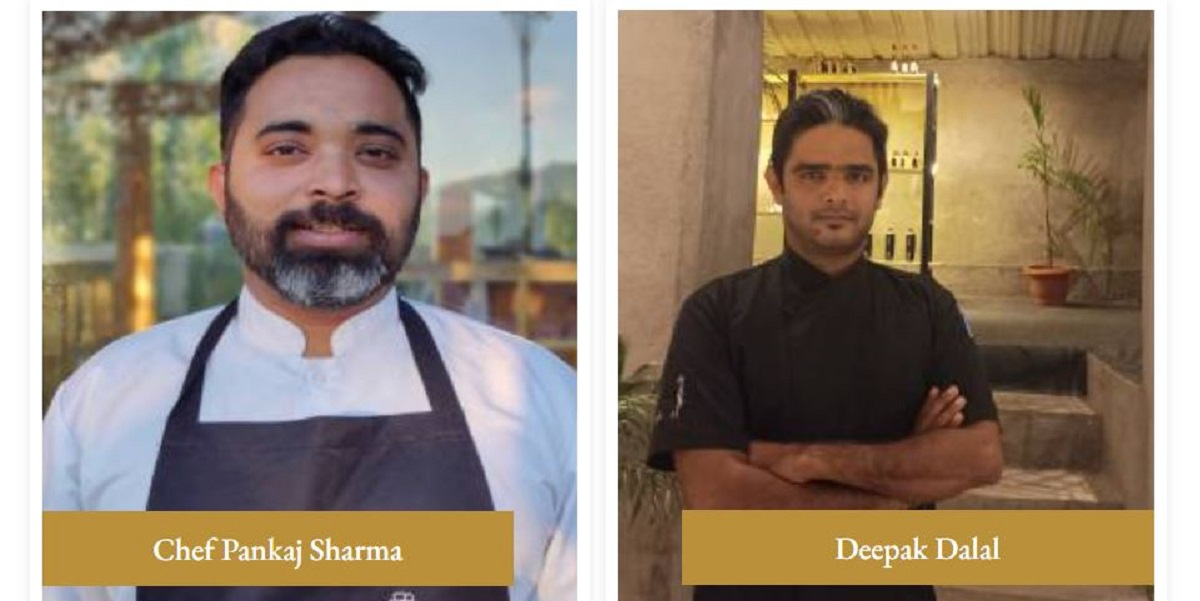
In the evolving landscape of Indian fine dining, Syah takes a distinctive approach by placing seasonality, local produce and a strong sense of place at the centre of its culinary experience. Located amid a farm and natural surroundings outside Udaipur, Rajasthan, the restaurant moves away from the idea of a fixed menu and instead allows the land, farmers and changing seasons to influence what appears on the plate.
Syah’s 12-course tasting experience explores Indian and regional flavours through contemporary culinary techniques, while maintaining a connection to the ingredients and memories that inspired each dish. Its seasonal operating model further reinforces the restaurant’s philosophy, giving the team time to experiment, work with farmers and develop new ideas between seasons.
In this interview, the team behind Syah discusses the thinking behind its seasonal approach, the role of local farmers and artisans, reinterpreting traditional flavours, and how the restaurant’s setting shapes the overall guest experience.
Interview with the Team Behind Syah
Q. Syah is built around the idea that the menu should change with the land and the season. What inspired you to build a restaurant where the availability of ingredients actually shapes the dining experience?
Syah: I think it started from our own curiosity about food. We realised that some of the most interesting ingredients around us were things we had grown up seeing but had never really thought of as restaurant ingredients.
In Rajasthan, you have so many things that appear for a very short period of time. You enjoy them when they are there, and then they disappear until the next season. We found that quite beautiful.
We didn’t want to build a menu and then find ingredients to fit into it. We wanted to work the other way around. See what is growing, what farmers are bringing us, what is available in the market, and then ask ourselves what we can do with it.
Of course, it is not always convenient. Sometimes you really like an ingredient and suddenly it is gone. But I think that is also the point. Food doesn’t always have to be available whenever we want it.
That relationship with seasonality is a big part of what Syah is about.

Q. From ingredients grown at your own farm to produce sourced from local farmers and artisans, how do you decide which local ingredient deserves a place in Syah’s tasting menu?
Syah: We don’t really have a fixed rule for it.
Sometimes it is the flavour that gets our attention. Sometimes it is the ingredient itself, because it is something unusual that we haven’t worked with before. And sometimes there is a story behind it that makes us want to explore it.
We spend quite a lot of time talking to farmers and people who have been working with these ingredients for years. They often know much more about them than we do. They know when something is at its best, how it has traditionally been cooked, or even which part of the plant people normally don’t use.
That becomes interesting for us.
The farm also helps because we can experiment with things on a small scale. We may grow something, taste it, try a few preparations and see where it takes us.
But being local is not enough on its own. The ingredient still has to taste good and make sense in the menu. We don’t want to put something on the plate just because we can say it came from Rajasthan.
Q. Your 12-course experience reinterprets Indian and regional flavours through modern techniques. How do you decide how far you can reinvent a traditional ingredient or dish without losing its connection to its roots?
Syah: This is probably one of the things we discuss the most in the kitchen.
When you take something familiar and change it too much, there is always a point where it stops feeling like the thing you started with. We try to understand what makes that ingredient or dish special before we start changing it.
It could be a particular flavour, a texture, a smell or even a memory.
Once we understand that, we are quite open with technique. We might ferment it, smoke it, clarify it, dry it or use it in a completely different form. But somewhere in the dish, there should still be something that connects you back to the original ingredient.
For me, the best reaction is when someone eats something at Syah and says, “I know this flavour, but I’ve never had it like this before.”
That is usually where we know we’ve got the balance right.
Q. Syah is located away from Udaipur’s usual luxury-dining setting, surrounded by the farm and nature. How important was this sense of place in shaping the restaurant’s identity and the way guests experience the food?
Syah: Very important. In fact, I don’t think Syah would be the same restaurant if it was in the middle of the city.
When people arrive, there is a little bit of a transition. They leave Udaipur behind, come out to the farm and spend some time here before dinner. We encourage guests to walk around, look at the farm, have a drink and just slow down.
That is important to us because the food makes more sense when you understand where it is coming from.
If you have just walked past the vegetables growing in the farm and then see one of them on your plate, it creates a different connection. You start noticing things that you might otherwise overlook.
The surroundings also change constantly. The light changes, the farm changes, the weather changes. So even though the restaurant is the same, the experience is never exactly the same.
We wanted Syah to feel connected to its location rather than simply being a restaurant that happens to be located outside Udaipur.
Q. Syah operates seasonally rather than throughout the year. What does closing and returning with a new seasonal experience allow you to do that a conventional restaurant model wouldn’t?
Syah: Honestly, closing is not always easy. From a business point of view, it would obviously be easier if we could just keep going.
But the season gives us something in return.
When we close, we get time to step away from the day-to-day operation and think about what we want to do next. We can work on new dishes, experiment with ingredients, spend more time on the farm and speak to farmers about what is coming in the next season.
It also means we don’t have to pretend that everything is available all year.
When we reopen, there is a sense of starting again. The menu changes, the farm has changed, and even the way we think about the restaurant has usually evolved a little.
I actually like that Syah is not exactly the same restaurant every year.
For us, the season is not a limitation. It is part of the reason the restaurant exists.
A Restaurant Shaped by Its Surroundings
Syah’s approach reflects a broader understanding of dining in which the restaurant, the farm, the ingredients and the people who cultivate them are part of the same story. Rather than treating seasonality as a constraint, the team uses it as a framework for experimentation and renewal.
From exploring ingredients with local farmers to applying modern techniques to familiar Indian flavours, Syah’s culinary philosophy is rooted in curiosity while remaining connected to Rajasthan. Its location outside Udaipur adds another dimension to that experience, allowing guests to encounter the ingredients in their natural surroundings before experiencing them through the tasting menu.
Ultimately, Syah’s seasonal rhythm creates a dining experience that is intentionally temporary and constantly evolving. Each season brings different ingredients, ideas and possibilities, making the restaurant’s identity less about maintaining a fixed menu and more about discovering what the land has to offer at a particular moment.