

The corporate world has spent decades searching for better ways to build leaders, strengthen teams and improve workplace performance. Yet an unconventional learning venture is turning attention away from conference rooms and toward the natural world.
Sai Kiran Bhagavatula, a Hyderabad based entrepreneur, spent 13 years in the information technology industry before making a dramatic career shift. His fascination with wildlife eventually became the foundation for Wildlife Whisperers, a venture that uses observations from animals and ecosystems to create learning experiences for corporate teams.
The idea is deceptively simple. Instead of studying leadership only through business theories and management case studies, employees can observe how animals survive, cooperate, communicate and respond to changing circumstances.
The Lion’s Lesson in Leadership
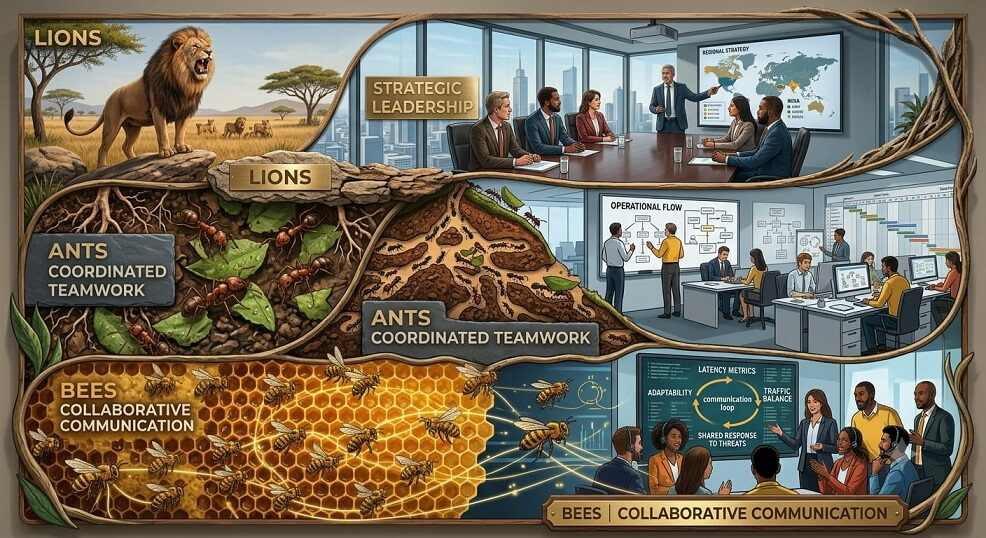
Lions offer one perspective. They live within social groups where cooperation and coordination can determine survival. Their behaviour can prompt teams to think about role clarity, collective responsibility and the importance of working toward a shared objective.
For corporate teams, the structure of a pride can become a powerful metaphor for strategic planning, accountability and coordinated decision making.
Teamwork Lessons From Ants
Then there are ants.
Tiny individually but remarkably effective collectively, ants demonstrate how coordinated action can produce results that would be impossible for one member of the colony.
Their behaviour offers a powerful metaphor for delegation, discipline, communication and contribution without the need for constant supervision.
What Bees Teach About Collaboration
Honey bees provide another lesson.
A colony depends on different members performing different functions while remaining connected to a common purpose. Their collective response to threats also illustrates how communication and adaptability can become critical when circumstances change.
For modern organisations, these natural systems offer an alternative way of thinking about workplace dynamics.
When Nature Becomes the Classroom
Modern companies operate in environments where markets shift rapidly, technology changes constantly and teams are increasingly distributed across locations. Technical expertise alone is often insufficient. Organisations also need people who can collaborate, adapt and make decisions under pressure.
This is where Wildlife Whisperers positions its approach differently from conventional corporate training. The venture combines wildlife experiences, storytelling and guided reflection to turn observations in nature into discussions about leadership, resilience, teamwork and mindfulness.
Bhagavatula’s career transition is itself an unusual example of professional reinvention. After spending more than a decade in the technology sector, he chose to pursue his interest in wildlife and transform it into an entrepreneurial venture.
The unusual combination appears to have found a commercial audience. According to the report, Wildlife Whisperers generated Rs 80 lakh in revenue during its first year. The company has also developed programmes for corporate organisations that combine wilderness experiences with learning and reflection.
A Different Way to Think About Leadership
The larger lesson may extend beyond one entrepreneur or one startup.
Companies frequently try to manufacture teamwork through processes, software and performance frameworks. Nature presents a different model. Cooperation emerges because individual members understand their role within a larger system. Adaptability is not treated as a corporate slogan. It is essential to survival.
That distinction could make nature based learning increasingly relevant to organisations searching for deeper forms of employee development.
The forest does not conduct leadership seminars. There are no PowerPoint presentations in a beehive and no annual strategy meetings inside an ant colony. Yet millions of years of evolution have produced systems capable of coordination, adaptation and collective action.
For executives willing to look beyond the traditional classroom, that may be the most valuable lesson of all.
Sometimes the best leadership lessons are not invented in a boardroom. They are already happening in the wild.